
Offering Memorandum · Self-Storage
Free Self-Storage Offering Memorandum (OM) Template: PowerPoint, Google Slides & AI
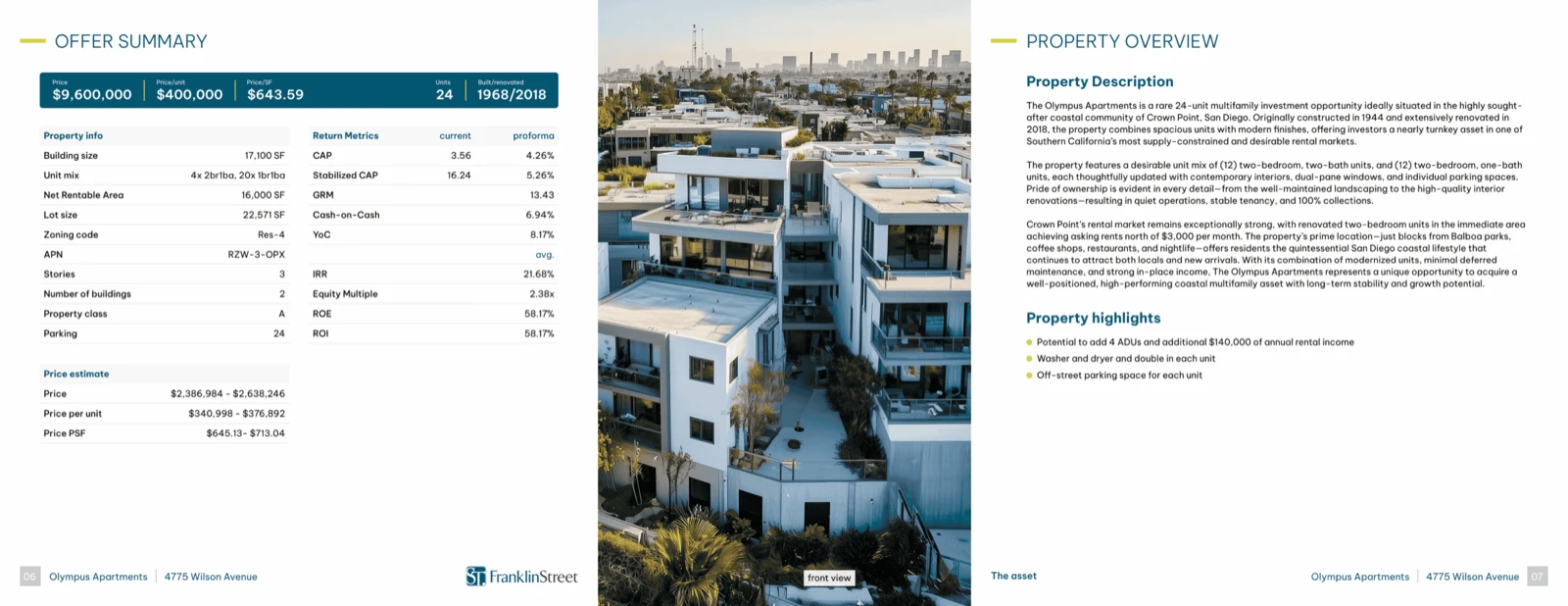
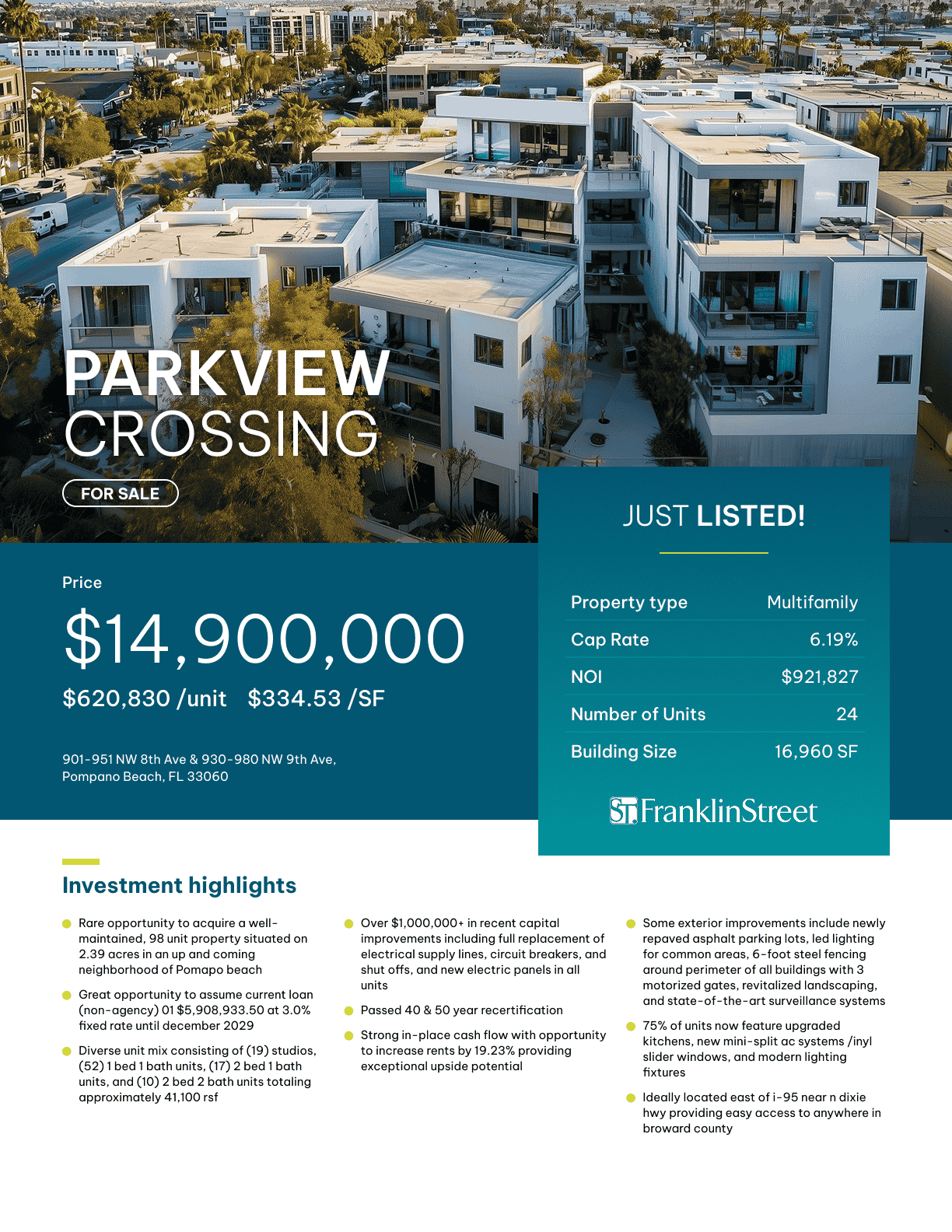
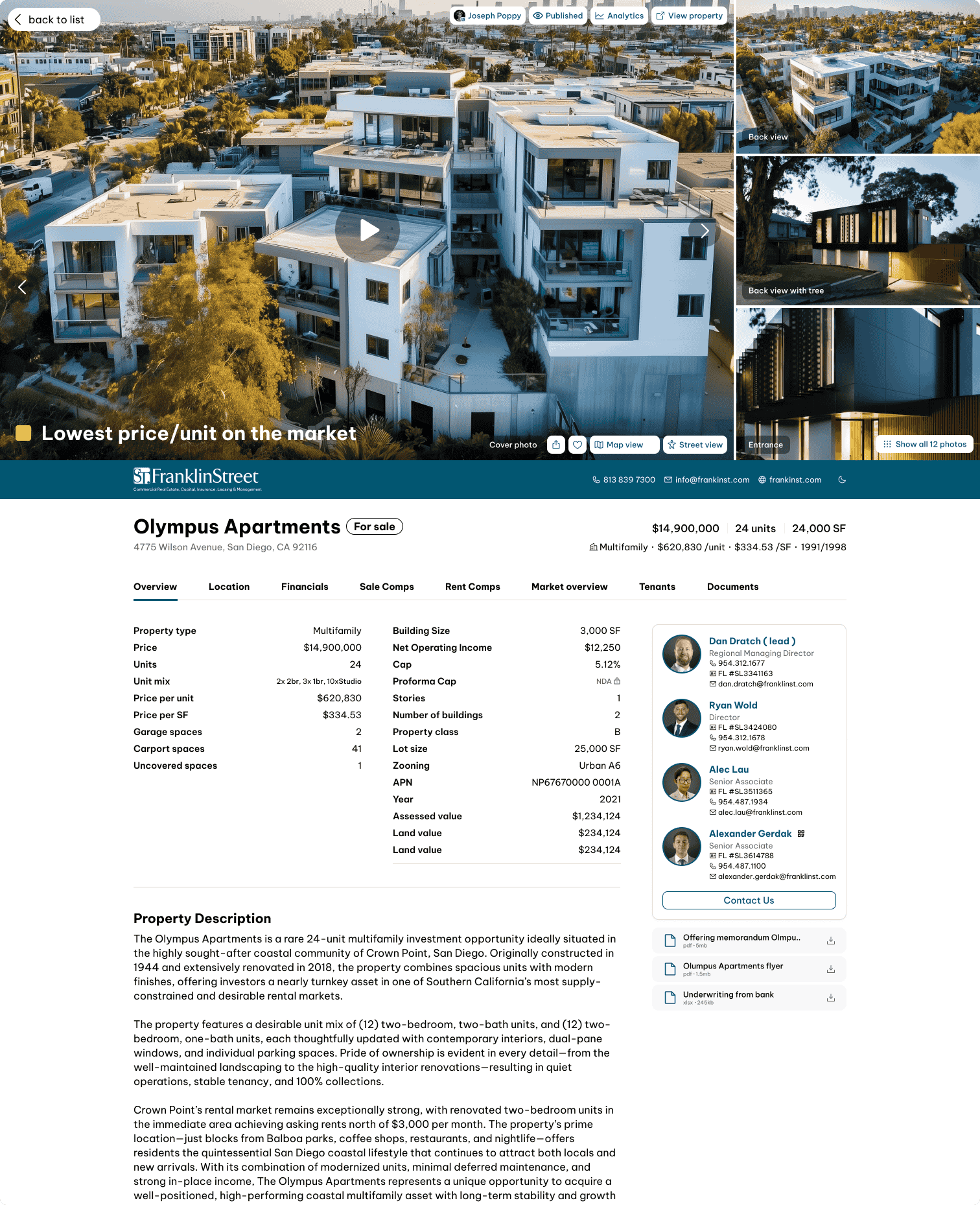
A brokerage-neutral self-storage offering memorandum in the same page order as the default OM in IntellCRE, with the pages self-storage buyers actually ask for. Placeholders only, no invented data.
What you get
- A PowerPoint OM with the IntellCRE page order and two self-storage-specific pages: Unit Mix and Occupancy by Size and Rate History and Revenue Management.
- A short “what goes here” note on every page and a placeholder for every figure; nothing is filled in with made-up data.
- A Keynote file, a Google Slides route (import the PowerPoint), a Markdown template, a Claude Skill, and prompt and custom GPT text for Claude, ChatGPT and Gemini.
See all free self-storage templates →
What makes a self-storage OM different
Self-storage is a high-turn, small-ticket rental business. Buyers examine unit mix, occupancy by size, street versus in-place rates and ancillary income, so the document replaces the rent roll with a size-level occupancy table and rate history.
That is why this template does not reuse a generic deck. The questions buyers ask first about self-storage property are specific, and the document should answer them without being asked:
- What are physical and economic occupancy, and how do they differ by unit size?
- How far are in-place rates from today's street rates?
- How much income comes from tenant insurance, fees and other ancillary sources?
- Is there land to expand, and what does expansion cost?
The metrics buyers look for
The summary page of this self-storage OM is built around six numbers. Show only the ones you can support with a source or a calculation.
- Price per net rentable SF
- In-place cap rate
- Physical occupancy
- Economic occupancy
- Street rate vs in-place rate
- Ancillary income
The property-data table beside them covers: net rentable sf and unit count, climate-controlled share, year built / expanded, site acreage and expansion land, management software and access control, tenant insurance or protection plan.
The self-storage-specific pages
Unit Mix and Occupancy by Size
Columns: Unit size, Type (climate / drive-up), Count, Occupied, Street rate, In-place rate, Delinquent. State the as-of date and where the figures come from.
Rate History and Revenue Management
Columns: Metric, Current, 12 months ago, Notes. Cite documents, not memory.
Comparables
Sale comps use these columns: Net rentable SF, Units, Sale price, Price per NRSF, Cap rate, Occupancy at sale, Year built. Rent or rate comps use: Facility, Unit size, Type, Street rate, Rate per SF, Promotions.
Assumptions to state
Every projection in a self-storage OM rests on assumptions a buyer will test. The Assumptions page has rows for: stabilized occupancy, street rate growth, rate increases on existing customers, ancillary income growth, marketing spend, exit cap rate.
Back it up: documents to have ready
A self-storage OM is only as credible as the documents behind it. Collect these before you publish figures.
Operations
- Unit-level rent roll from management software: Shows rates, move-in dates and delinquency by unit
- Rate history and rate-increase notices to existing customers: In-place versus street rates drive upside
- Aged receivables and lien-sale or auction records: Tests collections
- Web and call lead reports and marketing spend: Demand source
- Payroll and management agreement: Normalize expenses for a buyer's operating model
Revenue
- Tenant insurance or protection plan income and agreements: Ancillary income quality
Physical
- Roof, door and paving condition; fire and security systems: Capital needs
Compliance
- Zoning, certificates of occupancy and lien law compliance: Self-storage rules vary by state
Common self-storage mistakes
- Mixing physical and economic occupancy
- Quoting street rate as if existing customers pay it
- Counting tenant insurance income without agreements
- Skipping unit mix by size
Market data
The market page has rows for: supply of storage sf per capita, competing facilities within 3 miles, market street rates, population and household growth, renter and mover share, traffic count. Put the source and the date next to each one.
Use it with AI: Claude, ChatGPT, Gemini
Paste your deal facts and get a draft self-storage OM in this structure. The prompt uses only the facts you give it and marks gaps as [TBD].
Show the ready-to-paste prompt
You are a commercial real estate marketing analyst helping a broker draft a Self-Storage Offering Memorandum (Self-Storage OM).

Draft the Self-Storage OM in the structure below. Use ONLY the facts I give you. Where a fact is missing, write [TBD: what is needed] instead of guessing.

STRUCTURE
1. Intro
   - Cover Page: [Property name]; [Address]
   - Presented By: [Brokerage]; [counsel-approved disclaimer]
2. Executive Summary
   - Price estimate: [$]
   - Price per net rentable SF: [ ]
   - In-place cap rate: [ ]
   - Physical occupancy: [ ]
   - Economic occupancy: [ ]
   - Street rate vs in-place rate: [ ]
   - Ancillary income: [ ]
   - Net rentable SF and unit count: [ ]
   - Climate-controlled share: [ ]
   - Year built / expanded: [ ]
   - Site acreage and expansion land: [ ]
   - Management software and access control: [ ]
   - Tenant insurance or protection plan: [ ]
3. The Asset
   - Property Overview: [Description]
   - Photos and Area: [Captions; area description]
   - Points of Interest: [List with distances]
4. Unit Mix and Occupancy by Size
   - Unit size: [ ]
   - Type (climate / drive-up): [ ]
   - Count: [ ]
   - Occupied: [ ]
   - Street rate: [ ]
   - In-place rate: [ ]
   - Delinquent: [ ]
5. Rate History and Revenue Management
   - Metric: [ ]
   - Current: [ ]
   - 12 months ago: [ ]
   - Notes: [ ]
6. Financials
   - Income and Expenses / Development Budget: [Current and proforma; source and period]
   - Assumptions: Stabilized occupancy, Street rate growth, Rate increases on existing customers, Ancillary income growth, Marketing spend, Exit cap rate
7. Sale Comparables
   - Sale Comps Summary: Net rentable SF, Units, Sale price, Price per NRSF, Cap rate, Occupancy at sale, Year built
8. Rent Comparables
   - Rent Comps Summary: Facility, Unit size, Type, Street rate, Rate per SF, Promotions
9. Market Overview
   - Supply of storage SF per capita: [Value; source and date]
   - Competing facilities within 3 miles: [Value; source and date]
   - Market street rates: [Value; source and date]
   - Population and household growth: [Value; source and date]
   - Renter and mover share: [Value; source and date]
   - Traffic count: [Value; source and date]
10. Advisory Bios and Contact Us
   - Advisors: [Name, title, license, contact]

RULES
- Use only facts the user supplied. Never invent property data, tenants, statistics, comps or quotes.
- If a fact is missing, write [TBD: what is needed] in its place.
- Every market statistic needs its source and date as given by the user; otherwise mark it [TBD: source and date].
- Show arithmetic for any figure you derive and flag it as calculated.
- Write in plain, factual US English. Avoid unsupported superlatives.
- Avoid this self-storage mistake: mixing physical and economic occupancy.
- Avoid this self-storage mistake: quoting street rate as if existing customers pay it.
- Avoid this self-storage mistake: counting tenant insurance income without agreements.
- Avoid this self-storage mistake: skipping unit mix by size.
- Leave confidentiality and disclaimer text as [Insert the brokerage's counsel-approved language]; do not write legal text.

BEFORE YOU DRAFT
If essential facts are missing, ask me up to 8 short questions first, then draft once I answer.
If I say "just draft it", draft now and list every [TBD] at the end.

OUTPUT
Return the Self-Storage OM as clean Markdown, one heading per section above, followed by a checklist of every [TBD] item and every number I should double-check against source documents.

MY DEAL FACTS
[Paste property details, financials, rent roll, comps, market notes and anything else here.]
Fill it from a real deal
With the IntellCRE MCP connector, your assistant can pull the property, its unit mix and rents, and its selected comps from IntellCRE before it drafts. Or let IntellCRE build the document from your deal files: try IntellCRE, free to start.
Download Self-Storage Offering Memorandum (OM) Template
Free. No form, no email required.
Download the PowerPoint template (.pptx) Download for Keynote (.key)
AI formats: Claude, ChatGPT, Gemini
Claude Skill (.zip) Prompt for Claude, ChatGPT, Gemini (.md) Markdown template (.md) Custom GPT / Project instructions (.md)
Frequently asked questions
Is this the same as what IntellCRE generates?
The section and page order, and the names of the tables, follow the default offering memorandum in IntellCRE. The visual design here is deliberately plain so you can re-brand it.
Does it contain real self-storage data?
No. Everything to replace is in [brackets]. Use only facts you can source, and label projections as projections.
How do I use it in Google Slides?
Download the PowerPoint file, then in Google Slides choose File, then Import slides, and upload it.
Related templates
- All free Self-Storage templates
- Self-Storage Broker Opinion of Value template
- Offering Memorandum template for any property type
Other property types: