

The CRE Broker's Guide to Listing Websites: Why Every Deal Needs One
PDFs get opened once. Listing websites get bookmarked, revisited, and shared — and they're the highest-engagement format in CRE marketing.
Key takeaways
- A listing website is a property-specific microsite, not a portal listing — the distinction matters for both SEO and buyer experience.
- Listing websites generate 3–5x more repeat visits than PDFs, because buyers return to check for updates and share the URL with partners.
- Five elements drive tours and offers from a listing website — and most brokers include two things that actively weaken them.
- The listing website should be live before the OM — it's the first thing that goes out in the teaser, not the last thing you add.
What a listing website actually is (and isn't) — clear the confusion between listing portals and property microsites
When brokers hear "listing website," most of them think of a portal listing on CoStar or LoopNet — a page inside a larger directory where their property competes for attention alongside every other active listing in the market. That's not what we're talking about.
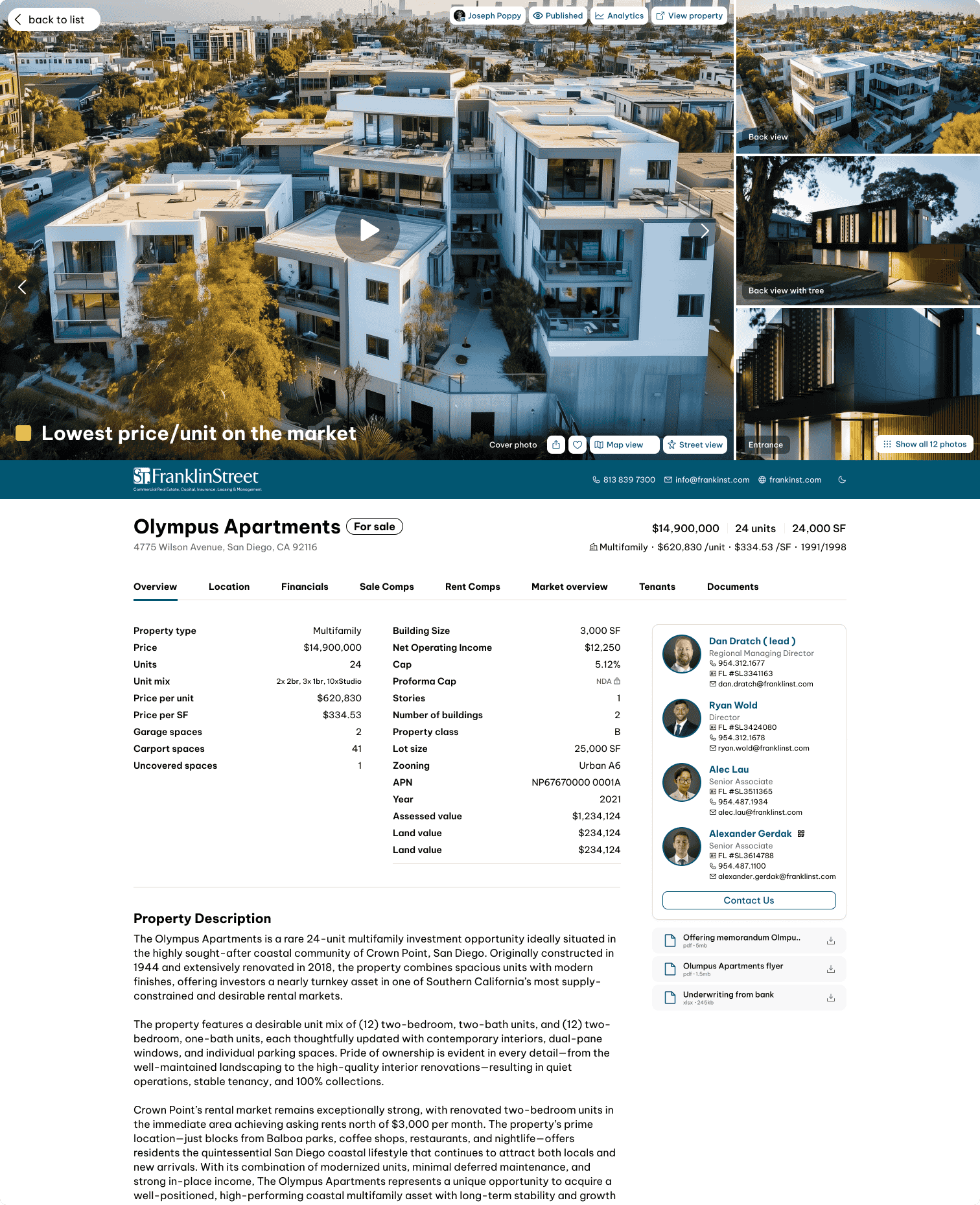
A property microsite is a standalone, deal-specific web page (or small multi-page site) built around a single listing. It has its own URL, its own design, and it presents the investment opportunity the way you want it presented — not inside a search grid where the buyer's attention is immediately pulled to comparable listings.
The distinction matters for several reasons. First, a microsite is controllable. You choose what appears above the fold, what imagery anchors the experience, and what call-to-action drives the next step. On a portal, you get a template. Second, a microsite is shareable in a way that feels intentional. When you send a buyer a URL like "propertyname.com" or a branded short link, it signals a professionally managed process. It signals that you've invested in the deal. Third, a microsite is indexable by search engines — which means deals with well-built microsites sometimes surface organically when buyers are researching a submarket.
The confusion between portals and microsites is worth clearing up because it changes how you budget your marketing time. Portal listings are table stakes — you need them for reach. Microsites are differentiators — they control the experience once a buyer is interested enough to look deeper.
Think of the portal as the billboard and the microsite as the showroom. You use the billboard to get people in. The showroom is where the deal actually happens.
Why listing websites outperform PDFs: engagement data, mobile traffic, bookmark behavior
A PDF is a static document. Once it's downloaded, you have no visibility into what happens next. You don't know if it was opened, how long the buyer spent on the financials page, or whether it was forwarded to a partner. You sent it into a black box.
A listing website is the opposite. Every visit is tracked, every section scroll is measurable, and every return visit tells you something about buyer intent. According to 101: Reinventing CRE Marketing with Property Websites, listing microsites generate 3–5x more repeat visits than PDFs — because buyers come back to review numbers, share the URL with partners and equity sources, and check for any updates to the deal terms.
Mobile behavior is the other piece. More than 60% of CRE deal research now happens on mobile — principals reviewing deals between meetings, on planes, in the car. A PDF is barely usable on mobile. A well-built listing website is fully responsive, loads the photos first, and puts the investment thesis on the screen before a buyer has to scroll. That's not a design preference — it's a functional advantage when you're trying to hold a buyer's attention for the 90 seconds it takes to decide whether to call you.
Bookmark behavior is the signal that most brokers miss. When a buyer bookmarks your listing URL, they're telling you they're in the process of making a decision — they need to come back to it. PDFs don't get bookmarked. Web pages do. A high bookmark rate on a listing page is one of the strongest leading indicators of a serious buyer before they've said a word to you.
Track your listing website's traffic. The buyers who visit more than three times before the offer deadline are your most likely offers.
What makes a great listing website: the five elements that drive tours and offers
Most listing websites fail because they try to replicate the OM online — every page of data, every exhibit, every footnote. That's the wrong model. The listing website has a different job: it needs to create enough interest to drive a specific next action, whether that's downloading the OM, scheduling a tour, or calling the listing broker.
Five elements consistently separate the listing websites that generate tours and offers from the ones that don't.
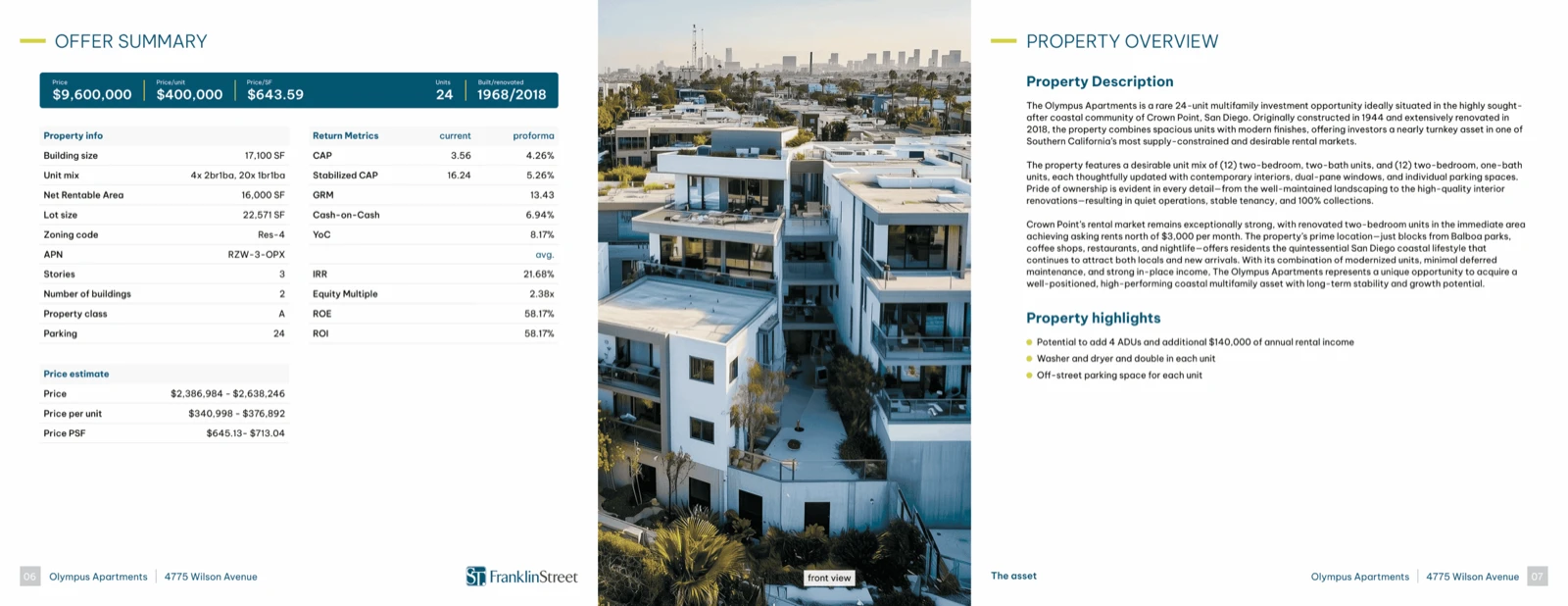
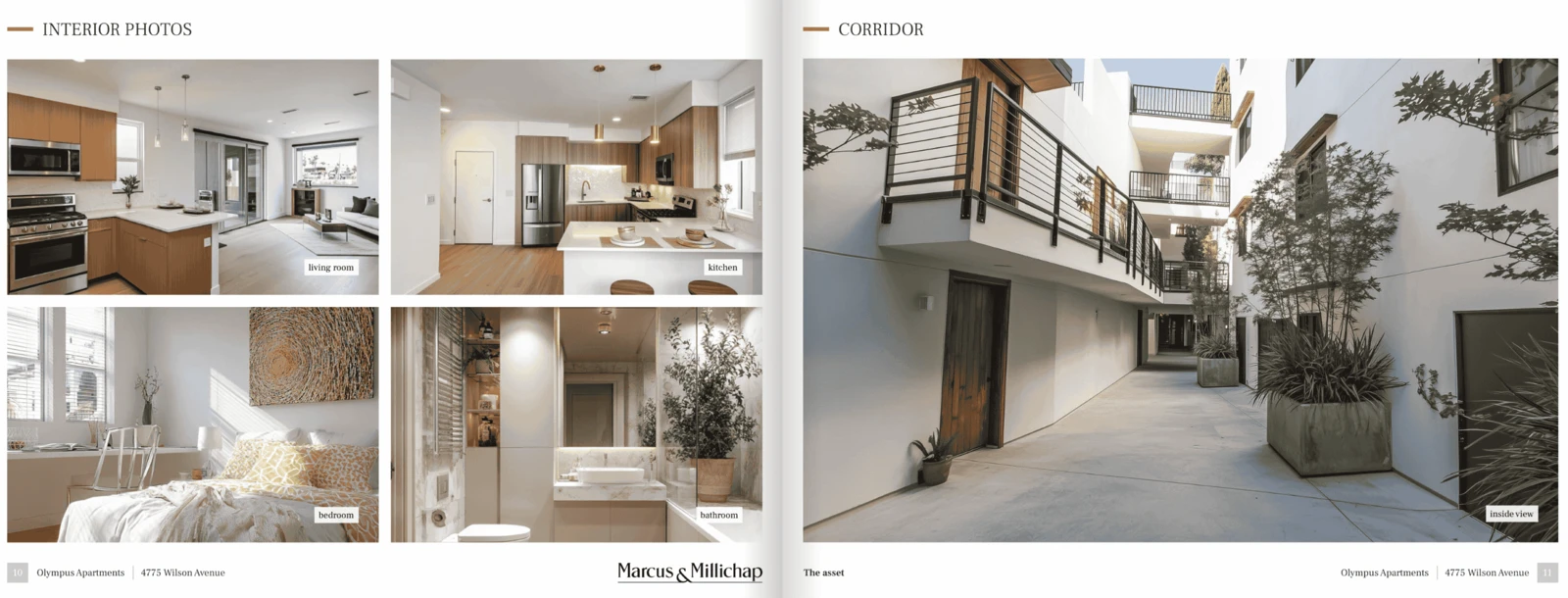
First, a hero image that does real work. Not a generic exterior shot with a flat sky — an image that captures the property's best angle, ideally with context (street activity, adjacent development, a full parking lot). The hero image is the deal's first impression online, and it needs to earn the next scroll.
Second, an investment thesis above the fold. Three to four sentences that tell a buyer exactly why this deal is worth their time, before they've seen the address or the asking price. Match it to your OM thesis word for word.
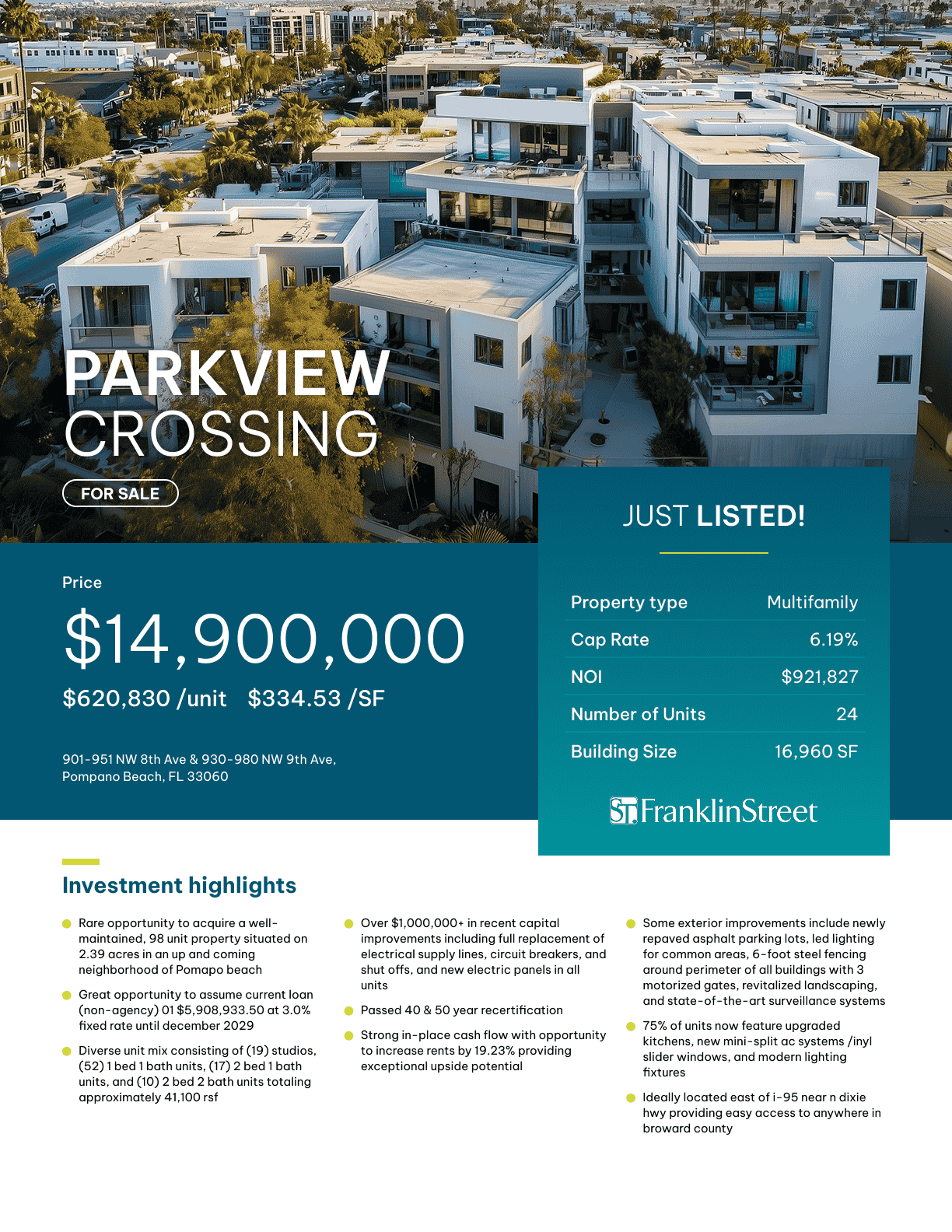
Third, a financial highlights block. Four to six numbers — price, NOI, cap rate, WALT, building size — presented in a clean visual format. No tables. No footnotes at this stage. Just the headline numbers that answer "does this fit my box?"
Fourth, a single, prominent call-to-action. One button that says "Download OM" or "Request Tour." Listing websites with multiple competing CTAs convert worse than ones with a single clear next step.
Fifth, broker contact front and center. Not in a footer. Not on a separate "contact" page. Name, phone, and email visible without scrolling on every device.
A listing website built around these five elements will outperform a more elaborate site that buries the thesis under architectural photography and market reports. Restraint is a feature, not a limitation.
How to distribute a listing website across email, social, and broker networks
A listing website you haven't distributed is just a URL. Distribution is where the asset earns its ROI.
Email is still the primary distribution channel for CRE deal marketing, and the listing website URL changes how you write the email. Instead of attaching a PDF, you link to the microsite. This makes your email lighter, faster to open, and more mobile-friendly — and it means every click is trackable. Write your subject line around the investment thesis, not the asset type and city. "Off-market NNN retail with 2028 lease event — [City]" outperforms "New Listing: Retail, [City]" because it front-loads the reason to open.
LinkedIn is increasingly where CRE deal flow circulates — not in a transactional way, but in a visibility way. A post that shares your listing website with a two-sentence deal thesis will reach principals you've never emailed. The comment section often surfaces introductions to buyers who aren't in your direct database. Post the link, not the PDF.
Broker-to-broker distribution is where most of your offers will actually come from. A listing website URL is easier to share between brokers than a PDF — and it keeps the deal presentation intact when it gets forwarded. Brief your top five buyer's broker relationships with a personal call or text before you blast the market. Give them the URL and two sentences about why the deal fits their buyer profile. Those five calls, before the market-wide email, will drive more serious activity than the blast itself.
Track click-through rates by source. Email campaigns to active buyers in your database will typically run at 18–25% open rates for a well-priced deal. Clicks to the listing site from email should be 8–15%. If you're below those numbers, the subject line or the deal pricing is the problem.
Building a listing website into your launch sequence — not an afterthought
The most common mistake brokers make with listing websites is treating them as the last thing that gets done — after the OM is finished, after the flyer is approved, after the email campaign is drafted. By the time the site is live, the launch energy has already gone into the first round of outreach without it.
The listing website should be live before the OM goes out — ideally before the teaser. Your launch sequence should look like this: teaser email (listing website link only, no OM yet) → call for interest from broker network → full launch with OM attached and listing website as the primary link → tour scheduling through the website.
The teaser-to-website step is where the listing website earns its place in the sequence. Sending a teaser with a live URL instead of a PDF creates a professional, intentional first impression. It says the deal is ready, the campaign is managed, and the process has structure. It also captures your earliest buyer interest — the buyers who click through on the teaser before the OM is even out are your most motivated.
For a seamless process, create your listing microsite in IntellCRE at the same time you generate your OM. Both pull from the same intake data, so there's no additional work to have the site ready when you need it.
The listing website also gives you something to update. If the deal gets a price reduction, the market shifts, or you want to add a new comp, you update one URL and every buyer who bookmarked it sees the change. A PDF sent two weeks ago cannot be updated. The microsite can. That flexibility alone makes it worth having in every deal from day one.
Frequently asked questions
Do I need a custom domain for each listing website?
Not necessarily. A branded short link or a subdomain (e.g., deals.yourbrokerage.com/propertyname) works well and is faster to set up than a standalone domain. The key is that the URL reads as intentional and professional — not a long string of platform-generated characters that looks like a tracking link.
How is a listing website different from a CoStar or LoopNet page?
CoStar and LoopNet pages exist within a directory where buyers are comparing you to every other listing at the same time. A listing microsite is deal-specific — the buyer is only looking at your property, in your framing, with your narrative. The portal drives discovery; the microsite drives conviction.
What should I include on a listing website vs. save for the OM?
The website handles first impression and deal qualification: hero image, investment thesis, headline financials, and one CTA. The OM handles the full due diligence case: rent roll, T-12, proforma, market deep-dive, and legal details. Don't try to put everything on the site — its job is to earn the OM download, not replace it.
How long should a listing website stay live after a deal closes?
Take it down or redirect it to a "sold" page within 30 days of closing. An active-looking listing site for a closed deal confuses buyers and reflects poorly on your market knowledge. A "sold" page, on the other hand, can be a positive signal — it shows transactional volume and builds your comp database.