
What is a Proforma in Commercial Real Estate?
A forward-looking financial model projecting a property's future income and expenses — and the document where most buyers decide whether a deal is worth pursuing.
Key takeaways
- A proforma is a forward-looking projection of a property's income and expenses — distinct from the trailing 12-month actuals that reflect what the property has actually produced
- Buyers underwrite proformas with heavy skepticism — the brokers who earn the most trust present conservative assumptions with clear line-item justifications
- The difference between a trailing 12 and a proforma isn't a technicality — it represents a claim about future performance that a buyer has to independently verify
- A credible proforma is a competitive advantage in a listing pitch: it shows the seller you understand their asset's upside without overpromising on price
The plain-English definition
A proforma — short for "pro forma," Latin for "as a matter of form" — is a forward-looking financial projection of a commercial property's income, expenses, and net operating income over a defined holding period. In CRE, proformas typically project 1–10 years of operations, though the most commonly referenced version is the Year 1 stabilized proforma: what will this property generate once it's operating at its intended lease-up and expense structure?
A proforma is built on assumptions, not actuals. That's the defining characteristic. Every line item — base rent, vacancy allowance, expense growth, management fees, capital reserves — reflects what you expect to happen, not what has happened. The discipline of building a credible proforma is the discipline of making defensible assumptions: ones you can walk a skeptical buyer through and have them accept as reasonable.
The proforma sits in contrast to the trailing 12 — also called T-12 — which is a historical income and expense statement showing what the property actually produced over the past 12 months. Trailing 12 is verified; proforma is projected. Buyers use the trailing 12 as the baseline for their underwriting and use the proforma to evaluate the broker's claims about upside. When those two documents tell inconsistent stories — when the T-12 shows deferred maintenance and rent concessions that the proforma doesn't mention — deals fall apart in due diligence and trust doesn't recover.
How brokers use it in practice
The proforma is where deals are made and lost. A broker who can present a credible proforma — one that a sophisticated buyer's underwriter will read and say "this is realistic" — has a measurable advantage over a broker who produces an optimistic fantasy that every buyer has to discount before they can use it.
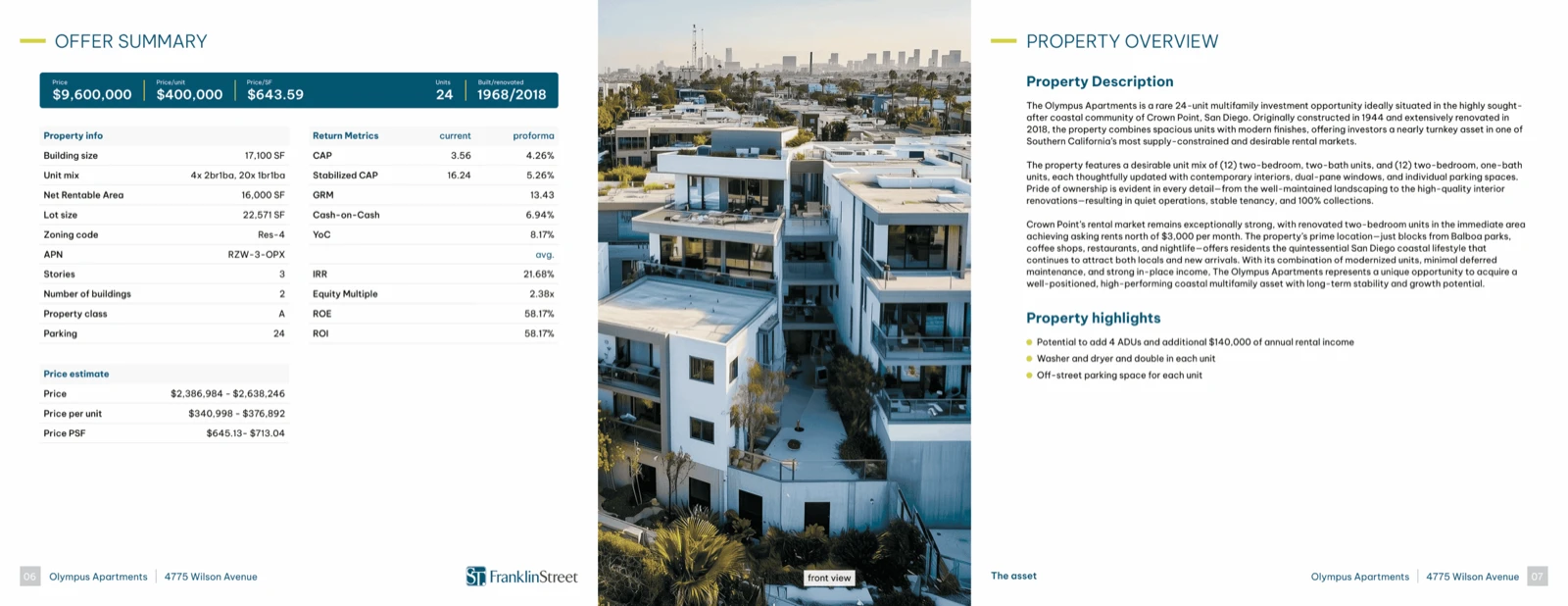
In practice, the best approach is to present both documents side by side: the trailing 12-month actuals as the verified baseline, and the proforma as the clearly labeled forward projection with each assumption explained. For a multifamily asset with below-market rents, the proforma line for gross potential revenue will be higher than the T-12 actuals — and that difference needs to be supported by executed lease renewals at higher rates, CoStar rent comps, or a documented lease-up schedule. Buyers will verify every assumption that materially affects value.
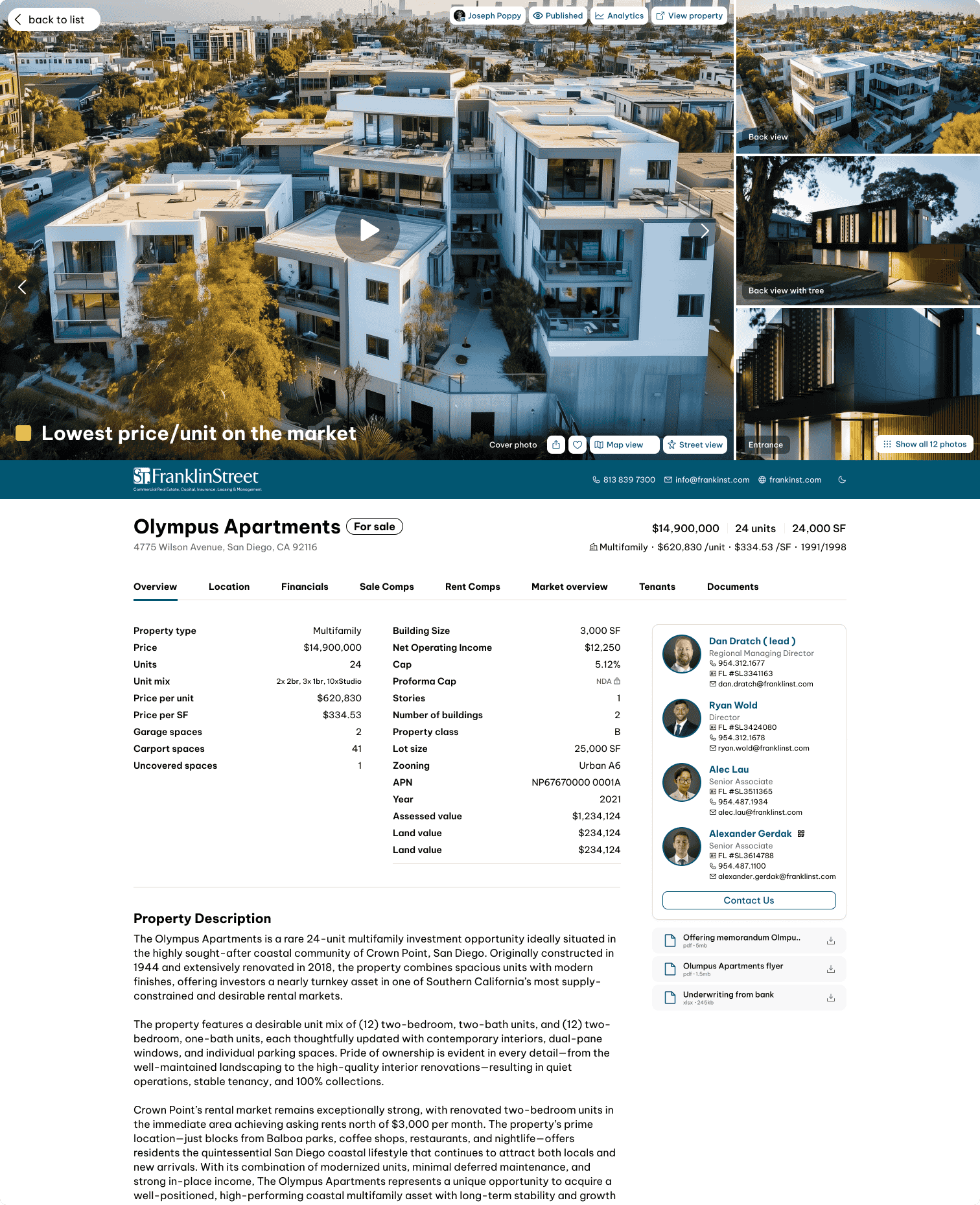
You can build a proforma that presents both the T-12 and the stabilized projection in a single formatted view using building a multifamily proforma in IntellCRE, which structures the comparison clearly enough that buyers can verify your assumptions without a separate request. That transparency accelerates the offer process because buyers spend less time trying to reconcile conflicting data and more time building conviction around the deal.
The most effective proformas for listing pitches are the ones that are slightly conservative — that show a realistic path to the projected NOI without requiring every assumption to hit perfectly. A proforma that pencils at 95% occupancy, 4% management fee, and 3% expense growth is a proforma buyers will accept. A proforma that requires 98% occupancy, a 2% management fee, and zero expense growth is one they'll reject and resent.
Common misconceptions
The most pervasive misconception is that a proforma is a best-case scenario document — a tool for showing a seller or buyer the maximum possible upside. Some brokers treat the proforma as a negotiating position rather than a realistic projection, inflating revenues and suppressing expenses to hit a target value. This strategy fails consistently with sophisticated buyers, who rebuild the proforma from scratch during underwriting and will catch every aggressive assumption.
The brokers who close the most deals at the highest prices present proformas that are conservative enough to survive buyer scrutiny. When a buyer's underwriter rebuilds your proforma and lands at the same NOI you projected — or even higher — you've won. That outcome generates trust, reduces retrade risk, and speeds the deal toward close. When the buyer's rebuild comes in materially lower, you've created a gap that someone has to bridge with a price reduction.
A second misconception is that the proforma and the rent roll are interchangeable. They aren't. The rent roll is a snapshot of current leases — who's in the building, at what rent, with what term remaining. The proforma is a model built on top of the rent roll that projects forward. You need both: the rent roll to establish the current baseline and the proforma to articulate the investment thesis. Presenting one without the other leaves buyers with an incomplete picture that slows the underwriting process and creates more questions than it answers. With AI underwriting tools that build from the rent roll up, the proforma and the supporting documentation stay consistent from the first draft.
Frequently asked questions
What's the difference between a proforma and a trailing 12 (T-12)?
The T-12 is a historical income and expense statement — verified actuals from the past 12 months. The proforma is a forward-looking projection of what the property is expected to produce. Buyers use the T-12 as their underwriting baseline and use the proforma to evaluate the broker's upside claims. Both documents are typically included in a well-prepared OM.
What vacancy rate should I use in a proforma?
Use the market vacancy rate for the asset class and submarket, not the property's current occupancy — unless current occupancy is lower, in which case you should model the lease-up timeline explicitly. Using a vacancy assumption below the market average requires specific justification: long-term leases, an anchor tenant, or documented below-market rents with strong retention history.
Should the proforma include capital expenditures?
Not in the NOI line, but yes as a separate item. Capital expenditures sit below the NOI line in a proforma and are presented as a separate cash flow adjustment. Including a realistic capital reserve — typically $200–$500 per unit annually for multifamily — demonstrates underwriting credibility and prevents the buyer from using deferred maintenance as a retrade argument during due diligence.
How many years should a proforma project?
For standard investment property underwriting, a 5- or 10-year proforma is typical. A 5-year hold model is most common for value-add deals where the business plan has a defined execution timeline. A 10-year model is more common for stabilized, long-term-hold assets. Year 1 projections are the most scrutinized; later years carry less underwriting weight but establish the exit cap rate basis.