

What is a Cap Rate (Capitalization Rate)?
Net operating income divided by purchase price — the most widely used shorthand for evaluating commercial property returns, and one of the most misread numbers in a deal.
Key takeaways
- Cap rate equals NOI divided by purchase price — it expresses an unlevered return on a property's income
- Cap rate is a communication tool as much as a financial metric — how you frame it in marketing materials affects buyer perception of deal quality
- A lower cap rate doesn't mean a worse deal; it often signals a higher-quality, lower-risk income stream in a supply-constrained market
- Always clarify whether the cap rate in your marketing is based on current NOI, trailing 12, or pro forma — buyers underwrite differently depending on the basis
The plain-English definition
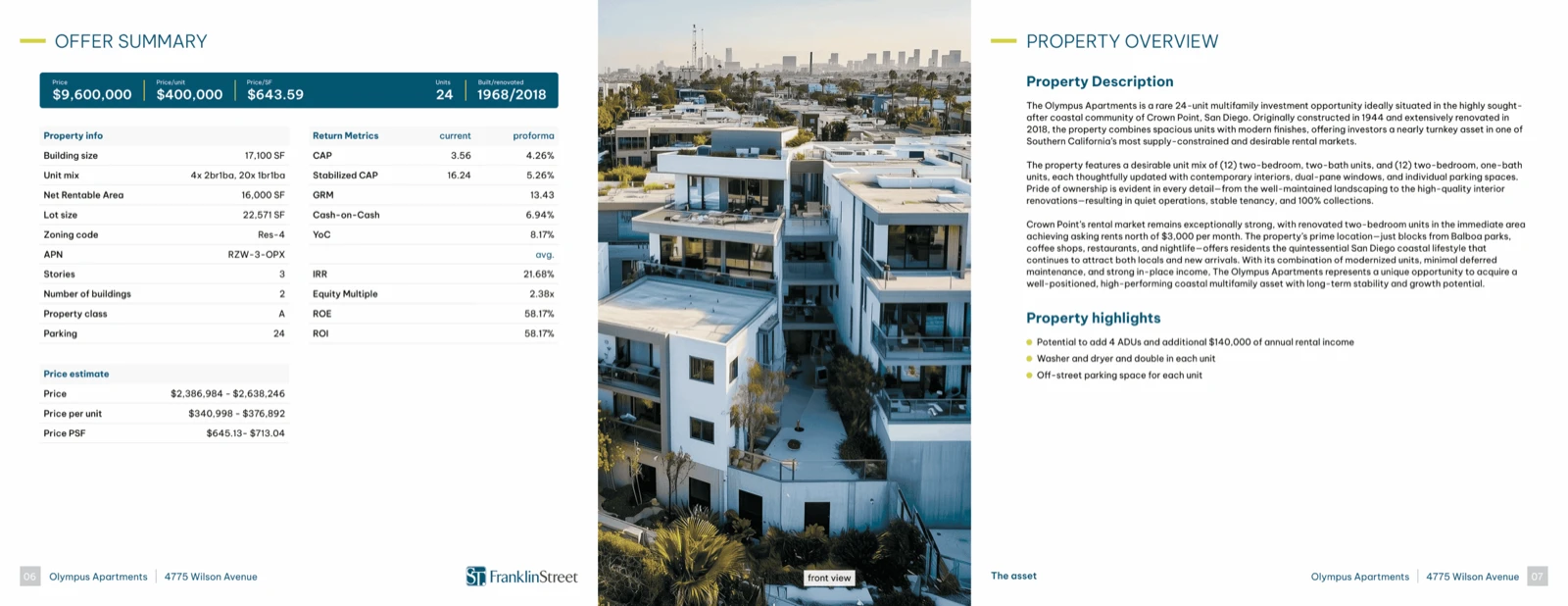
Cap rate — short for capitalization rate — is calculated by dividing a property's net operating income (NOI) by its purchase price or current market value. If a property generates $120,000 in NOI and is priced at $2,000,000, the cap rate is 6.0%. It's the most commonly used metric for comparing commercial investment properties on an apples-to-apples basis, because it strips out financing and focuses purely on the income the property generates relative to its cost.
Cap rate is an unlevered metric — it doesn't account for how a deal is financed. Two buyers purchasing the same property with different debt structures will have very different cash-on-cash returns, but they'll both look at the same cap rate when evaluating the deal. This makes cap rate useful for market-level comparisons: you can look at where cap rates are trading across a submarket to understand whether values are compressing or expanding, even without knowing the financing on any individual deal.
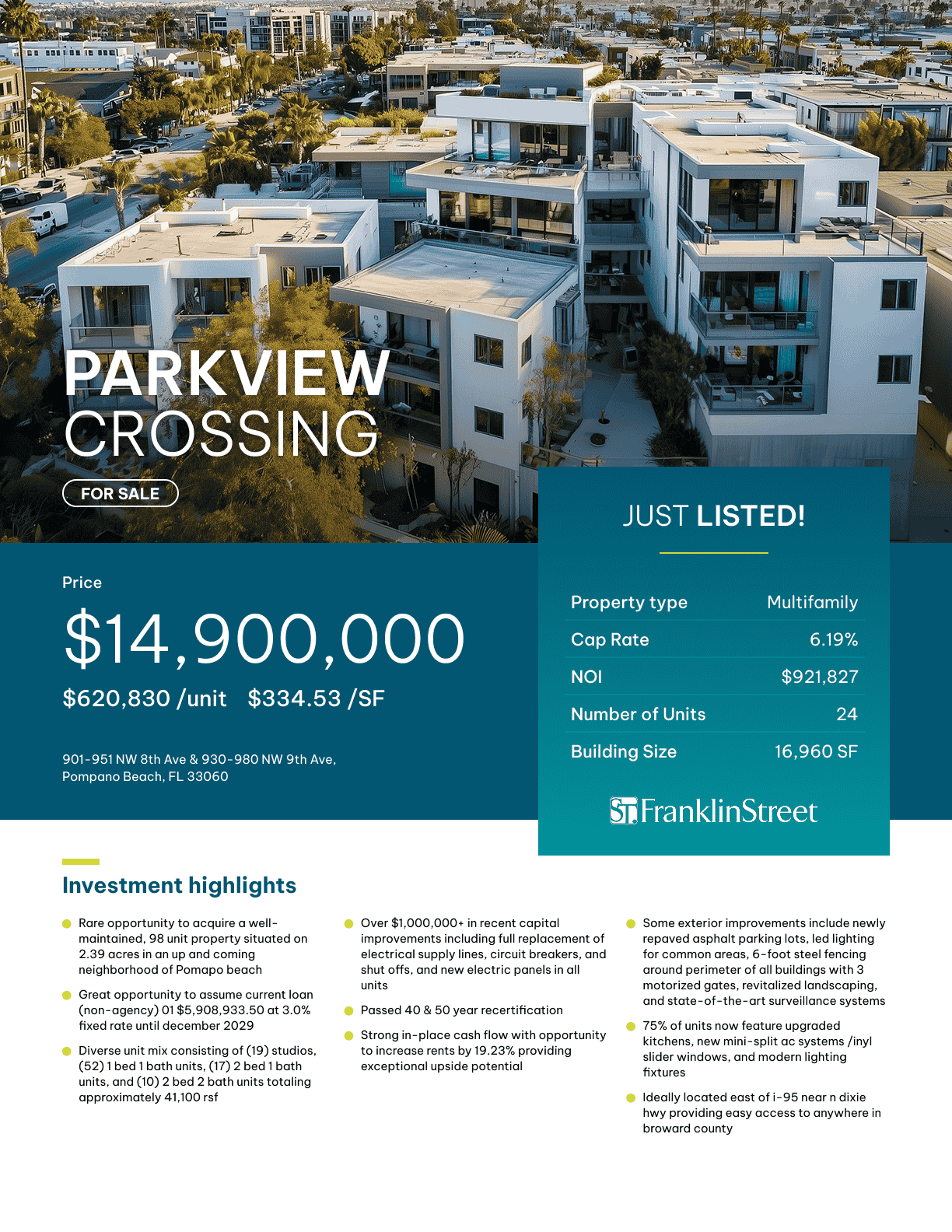
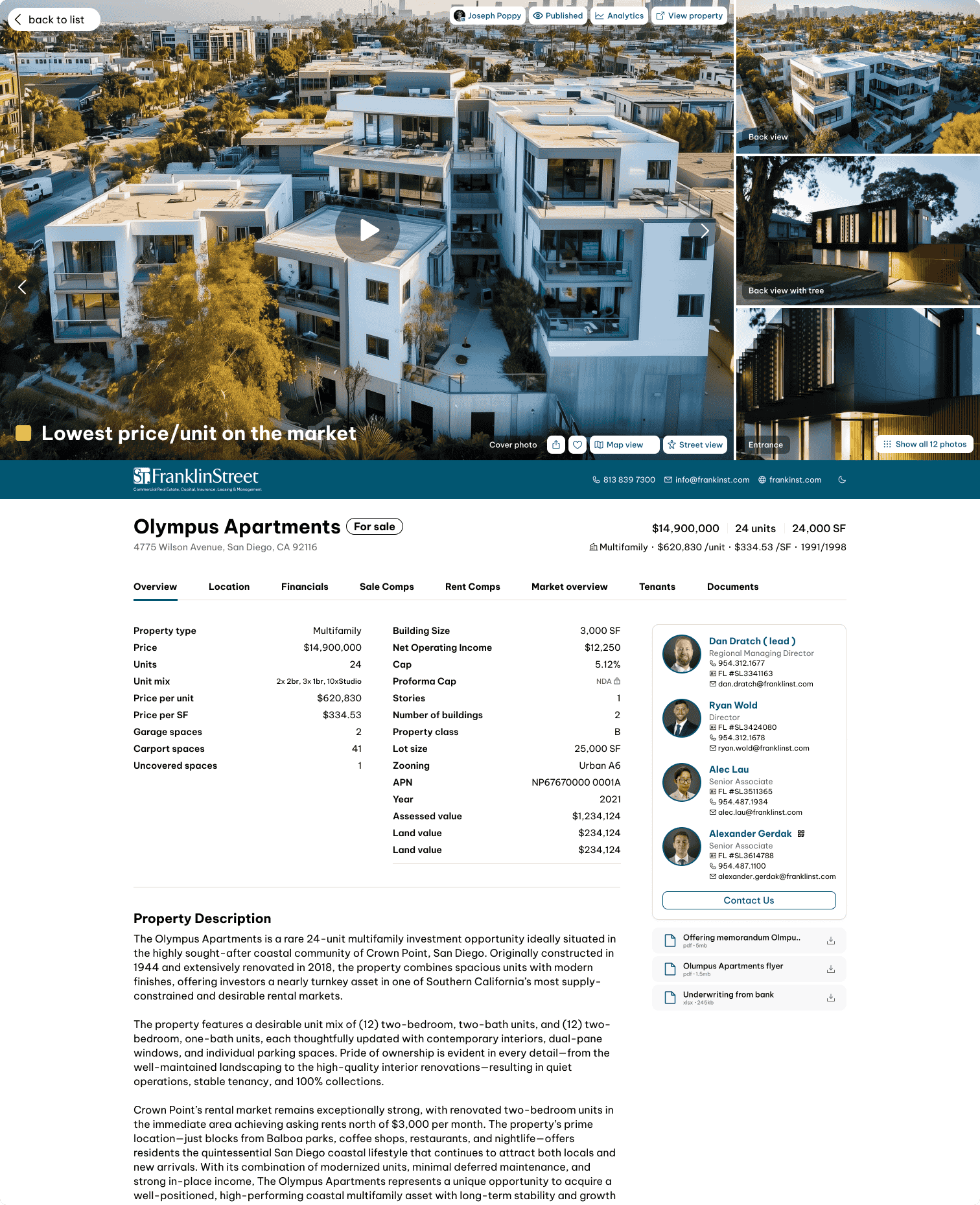
In marketing materials, cap rate is typically expressed as a trailing 12-month figure (based on actual collected income), a current in-place figure (based on current rent roll), or a pro forma figure (based on projected stabilized income). Each basis tells a different story, and buyers know the difference immediately. The moment your cap rate looks artificially high because it's based on an optimistic pro forma with below-market management fees, you lose credibility with the buyers who matter most.
How brokers use it in practice
Cap rate is the first number sophisticated buyers look for in an OM or property summary — before they read the narrative, before they look at the photos, and often before they read the address. Getting your cap rate framing right is a marketing decision with real financial consequences.
In a priced deal, your cap rate is implicit: if you're asking $3,000,000 on a property with $180,000 NOI, you're marketing at a 6.0% cap. Buyers in that market will immediately compare that to where comparable assets are trading. For current cap rate benchmarks by asset class, see the CRE Marketing Benchmarks 2026. If your submarket is trading at 5.5%–6.0% caps, you're priced at market. If it's trading at 5.0%–5.25%, your pricing signals value and you'll generate interest. If the market is 6.5%, you're overpriced and will sit.
For broker marketing, the most important skill is being able to explain cap rate in terms that translate to owner conversations. Owners don't always think in cap rates — they think in terms of what they paid, what they're netting, and what they could do with the proceeds. Translating a 5.5% cap rate into "your building is worth 18x your annual NOI, and that multiple has compressed 2 full turns in your submarket over the past 36 months" is how you create urgency in a seller conversation. The Owner Prospecting Guide covers how to frame cap rate data in BOV and prospecting contexts.
Common misconceptions
The most pervasive misconception is that a lower cap rate automatically means a worse investment. It doesn't. Cap rate compression — when cap rates move lower over time — is actually a signal of increasing demand and rising values. A 4.5% cap rate on a Class A net-lease property in a supply-constrained coastal market often represents a more certain, lower-risk income stream than a 7.5% cap rate on a value-add property with near-term lease rollover and deferred maintenance.
A related misconception is that cap rate and cash-on-cash return are the same thing. They're not. Cap rate is pre-financing. Cash-on-cash is what the investor actually earns on their equity after debt service. In a leveraged deal, cash-on-cash can be significantly higher than cap rate — and that's often the more relevant number for individual investors who are financing with debt.
Frequently asked questions
What's a "good" cap rate?
It depends entirely on asset class, market, and risk profile. Core assets in major coastal markets may trade at 4.0%–5.0% caps. Value-add or secondary-market deals may trade at 7.0%–9.0%. There is no universally good cap rate — the question is whether the cap rate reflects the risk you're taking.
What's the difference between going-in cap rate and exit cap rate?
Going-in cap rate is based on the NOI at the time of purchase. Exit cap rate is the projected cap rate at the time of sale — typically used in a 5–10 year hold model to estimate the disposition value. Buyers underwriting value-add deals often assume exit caps 25–50 basis points higher than going-in caps to account for aging and market risk.
Can you use cap rate for a vacant building?
Not directly. Cap rate requires stabilized NOI, which a vacant or partially vacant building doesn't have. For value-add or vacant properties, buyers typically underwrite to a stabilized pro forma and then discount for the time and cost required to reach stabilization.
How does interest rate movement affect cap rates?
Cap rates generally track interest rates — when borrowing costs rise, buyers require higher returns to hit their equity hurdles, which pushes cap rates up and values down. The relationship isn't perfectly correlated, but rising rate environments typically create cap rate expansion, which is why values compressed in 2022–2023 as rates climbed.