

Best LoopNet Alternatives for CRE Brokers in 2026
LoopNet premium is priced per market, and it adds up. Here is what actually moves listings — and where else your marketing budget goes further.
Key takeaways
- LoopNet has the largest broker audience but not necessarily the most motivated buyers for your specific deal.
- CREXi is the strongest portal alternative — growing fast, with auction capability and better buyer engagement data.
- Your own listing website outperforms most portal listings for mid-market deals because it's bookmarked, revisited, and shareable without a paywall.
- The highest-converting distribution stack: owned listing website + CREXi + targeted email to your buyer list + LinkedIn.
What LoopNet actually delivers — and what it doesn't
LoopNet is the largest commercial real estate listing portal in the country by audience size. That's real. If you list a property on LoopNet without a premium upgrade, you get some baseline exposure to brokers who search it daily. If you upgrade to Diamond or Platinum, you get featured placement, higher search visibility, and access to buyer contact data.
What LoopNet delivers well: broad exposure to an active broker and principal audience. For institutional assets, larger CBD office listings, and any deal where the buyer is likely to be an unknown party coming through a search, LoopNet coverage matters. Brokers who are new to a market and don't yet have a developed buyer list benefit most from portal exposure.
What LoopNet doesn't deliver: qualified engagement. LoopNet traffic is broad, and it includes a lot of passive browsing — investors who are watching the market but not actively transacting, tenants doing competitive intelligence, and brokers looking at comps rather than representing active buyers. The click-through and inquiry numbers look good; the conversion numbers are harder to pin down.
The more important question is whether portal spend is the right investment at all for your deal type. For a well-priced, clean industrial or multifamily asset in a market where you already have a buyer list, your own targeted email + CREXi listing will often generate more qualified inbound than a LoopNet premium upgrade. For a niche asset type — specialized medical, automotive retail, self-storage — the buyer pool is small enough that no portal reaches them efficiently anyway. Direct outreach to known operators outperforms portal exposure for these deals every time.
Before you renew or upgrade a LoopNet subscription, track your last five deals: how many buyers came from LoopNet specifically, and how many came from direct outreach or referral? Most brokers who do this analysis find the portal contribution is lower than they assumed.
Best portal alternatives to LoopNet
CREXi is the strongest LoopNet alternative available in 2026 and is the default first stop for brokers evaluating portal diversification. Its buyer and broker audience has grown significantly over the past three years, and it now has sufficient density in most major markets to generate meaningful deal flow. CREXi's call-for-offers and auction functionality gives it a capability LoopNet lacks — for deals where a structured competitive process makes sense, CREXi runs it in-platform. Listing on CREXi is free; the premium tiers add analytics, buyer contact info, and featured placement. List here regardless of whether you stay on LoopNet.
Catylist serves secondary and tertiary markets where CoStar/LoopNet audience density is thin. In markets under 300,000 population — or in states where local broker associations maintain commercial MLS data — Catylist often outperforms LoopNet on a qualified-inquiry basis. It integrates with many local commercial MLS systems, so listings get in front of locally active brokers who don't necessarily run LoopNet searches. If your deals are in the middle of the country or in smaller MSAs, explore Catylist before paying for a LoopNet premium upgrade.
Brevitas is positioned for the off-market and institutional end of the market. Its audience is smaller but more curated — family offices, private equity buyers, institutional operators. For NNN assets, net-leased retail, and stabilized multifamily over $5M, Brevitas reaches a buyer profile that LoopNet doesn't target well. It's not a replacement for LoopNet volume; it's a supplement for institutional deal quality.
CommercialMLS and regional platforms vary significantly by market. In some MSAs, local commercial MLS participation is effectively mandatory for broker cooperation. Know your local market — ask your top three buyer broker relationships where they actually search. The answer varies more by geography than most national platform comparisons suggest.
Honest verdict: CREXi replaces LoopNet effectively for most brokers in major markets. Catylist is the right secondary-market complement. Brevitas adds value for institutional deal types. No portal replaces direct outreach to your buyer list.
The listing website as the highest-ROI alternative
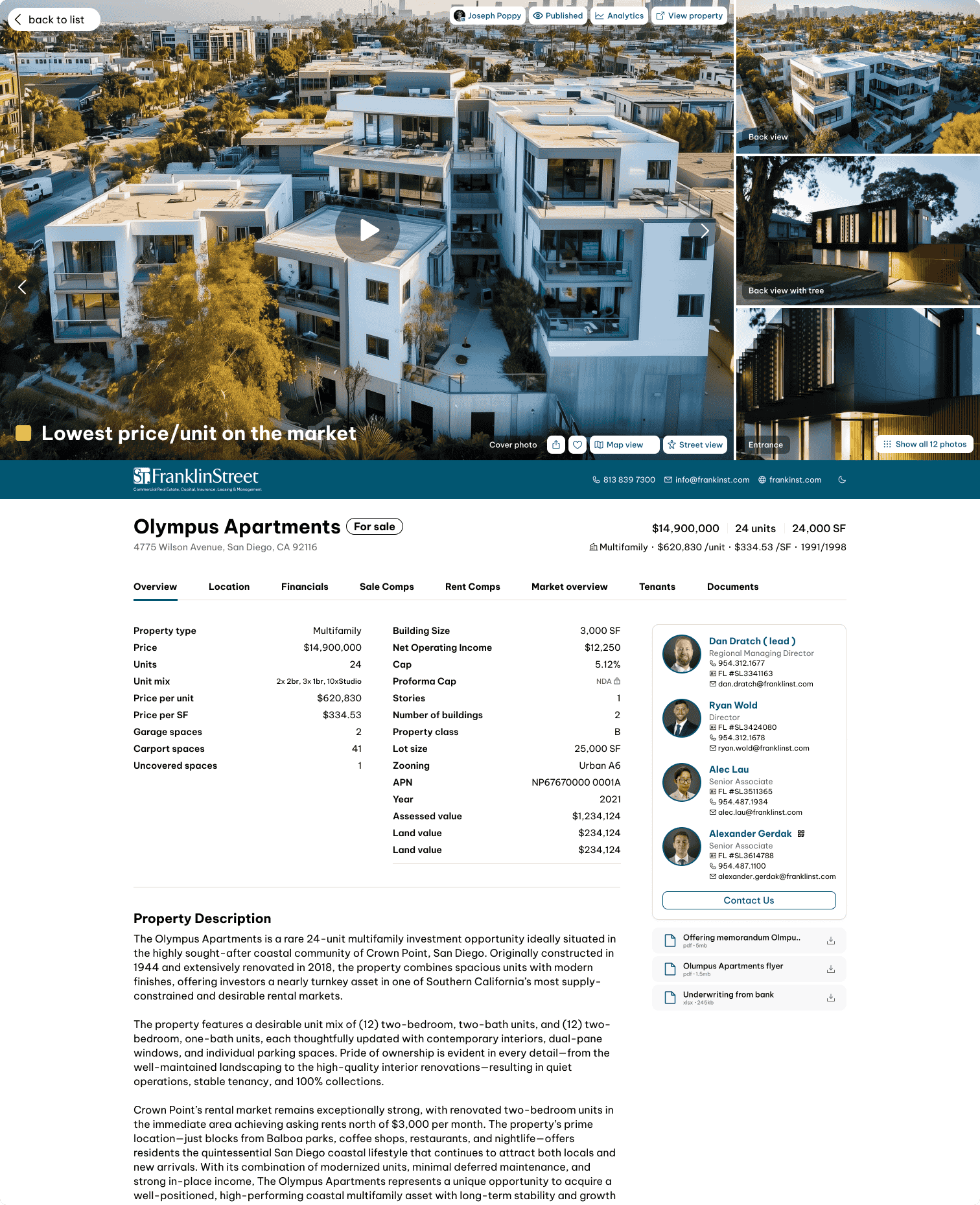
The strongest alternative to LoopNet premium spend is not a competing portal. It's a dedicated listing website for each property — a microsite you own and control that becomes the primary marketing destination for the deal.
Here's why it outperforms portals for most mid-market deals. A LoopNet listing puts your property inside a portal that the buyer may or may not search, surrounded by competing listings, with the portal's branding prominent and yours secondary. A dedicated listing website gives the buyer a destination that is about one property, with your brand front and center, accessible directly via a link you control.
Buyers who are genuinely interested in a deal don't browse portals — they get sent a link by you or their broker. That link can go to a LoopNet page or it can go to a property microsite you own. When it goes to your site, you capture the traffic data: who visited, how long they spent, how many times they returned. When it goes to LoopNet, LoopNet captures that data.
The revisit pattern is what makes listing websites disproportionately valuable. An interested buyer or buyer's rep will look at the property multiple times during their evaluation — comp checks, internal presentations, board approvals. Each of those revisits goes to your URL. Some brokers track 8–12 sessions per serious buyer on a listing website before they receive a LOI. That engagement data tells you which buyers are warming up.
The tactical argument from 101: Reinventing CRE Marketing with Property Websites is straightforward: a listing website shared in your launch email becomes the permanent home for that deal. It's bookmarked, forwarded, and shared without a paywall. Every link you send to every buyer goes to a page you control, not a portal that charges you for the privilege.
If LoopNet premium is a real line in your budget: redirect some of it to producing a better listing package — professional photos, a well-produced OM, a dedicated listing website — and distribute it through CREXi and your own buyer list. The conversion rate improves because the quality of the first impression improves.
The right distribution stack for independent brokers
The goal of listing distribution is not maximum impressions. It's maximum qualified buyer engagement. Those are different objectives, and optimizing for one often degrades the other.
For an independent broker or small team handling mid-market deals ($1M–$20M), the highest-performing distribution stack is layered — not dependent on any single channel.
Layer one is your owned listing website. This is the anchor of the entire campaign. Every other channel links back to it. It captures engagement data, it's accessible without a login, and it represents your brand rather than a portal's brand. Build this first, before you list anywhere.
Layer two is CREXi. It has sufficient buyer and broker density in most markets to generate meaningful exposure, it's free to list, and the call-for-offers functionality gives you an optionality that LoopNet doesn't. List here as part of your standard launch process.
Layer three is targeted email to your buyer list. This is your highest-conversion channel if your list is current and segmented. A list of 200 qualified buyers who have transacted in your market in the last three years — filtered to the relevant property type and check size — will generate more serious inbound than a LoopNet premium listing in most cases. The key variable is list quality. A generic 5,000-person blast converts worse than a targeted 150-person send. Build and maintain your buyer list as a core asset.
Layer four is LinkedIn. A deal post — property photo, key metrics, your contact — gets in front of your professional network and often generates direct referrals from brokers who know buyers. It doesn't replace the other channels, but for a 15-minute investment it adds brand visibility and occasionally surfaces a buyer directly.
This stack — owned site, CREXi, targeted email, LinkedIn — beats a LoopNet premium subscription for most mid-market deals. The total direct cost is lower, the engagement quality is higher, and you retain the buyer relationship data rather than surrendering it to a portal. If you're in an institutional market and volume exposure matters, add LoopNet as a fifth layer rather than treating it as the primary strategy.
Frequently asked questions
Is CREXi actually a good LoopNet replacement?
For most property types in major and mid-size markets, yes. CREXi's buyer and broker audience has grown enough to generate meaningful deal flow, the listing tool is comparable to LoopNet, and the call-for-offers functionality is a genuine capability advantage. The gap is in secondary and tertiary markets where LoopNet still has stronger broker penetration — in those cases, use both or add Catylist.
Is LoopNet premium worth paying for?
LoopNet prices premium placement by tier and by market, so the answer depends on where you list and how much visibility you buy — their site has the current rates. The question worth asking is what the placement returns. If premium placement across several markets is a standing cost, compare it against spending the same money on the listing package itself: better photography, a stronger OM, a dedicated listing site, distributed through channels you control.
Does having a listing website replace portal listings entirely?
Not for all deal types. A listing website should be the anchor of your distribution — the destination every channel points to — but it doesn't create initial discovery the way portals do for buyers who are actively searching. Use your listing website as the primary destination, use CREXi and targeted email for distribution, and add LoopNet if the deal type or market warrants broad portal exposure.