


CRE Marketing Software: The Complete Guide to the 2026 Landscape
There is no single tool that does everything. Here is the full CRE marketing tech stack — organized by what each tool actually does — so you can build the right combination for your practice.
Key takeaways
- Five distinct jobs in CRE marketing require five distinct tool categories — no single platform handles all of them well.
- Document creation is the highest-leverage category because it directly determines how deals are perceived by buyers and owners.
- Listing distribution works best as a layered stack: owned listing website + CREXi + targeted email, not a single portal subscription.
- Email outreach to a maintained buyer and owner list consistently outperforms portal spend on a cost-per-qualified-contact basis.
How to think about CRE marketing software
The most common mistake brokers make when evaluating marketing software is looking for one platform that does everything. That platform doesn't exist. The jobs in a CRE broker's marketing workflow are genuinely different from each other — different data, different outputs, different audiences — and tools that try to do all five jobs typically do none of them well enough to trust with your most important deals.
The cleaner mental model is five jobs, five tool categories. Job one is document creation: OMs, BOVs, flyers, listing websites, pitch decks. This is where your deal story lives and where buyer perception is formed. Job two is listing distribution: getting properties in front of potential buyers through portals, your own site, and email. Job three is contact and pipeline management: tracking who you know, what deals are in motion, and what your last communication was. Job four is email outreach: prospecting to owners, updating buyers, farming a submarket with market intelligence. Job five is content and social: LinkedIn presence, market commentary, brand-building that generates inbound over time.
Each job has a clear best-in-class tool category. The mistake is asking any one tool to do two or more jobs it wasn't designed for — and then blaming the workflow when the output is slow or substandard.
When evaluating any new piece of software, start with the job, not the feature list. Ask: which of the five jobs is this tool actually designed to do, and what is the evidence that it does that job better than my current approach? If the answer is unclear after a 15-minute demo, that's the answer.
The other framing that matters: time cost is the primary variable for most independent brokers. A tool that cuts 8 hours of OM production down to 45 minutes generates more value than a tool that cuts a $300/month portal subscription to $150/month. Prioritize tools that reduce the jobs that eat the most time. For most brokers, that is document creation by a significant margin — 10–20 hours per deal, every deal, for the career of the practice.
Document creation tools — the highest-leverage category
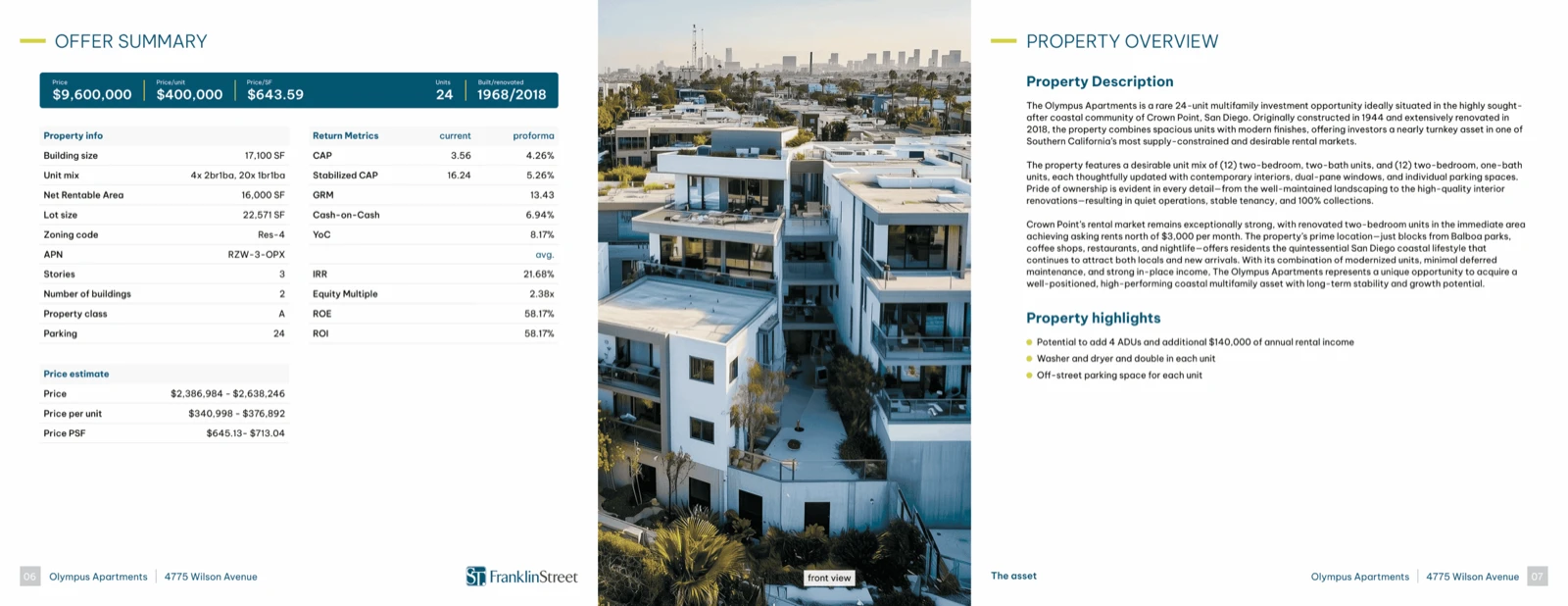
Document creation is where deals are won or lost before a single conversation happens. A well-produced OM signals that the broker is prepared, that the deal is serious, and that the seller has representation worth engaging with. A template-looking, inconsistently formatted OM signals the opposite. Buyers and their advisors notice.
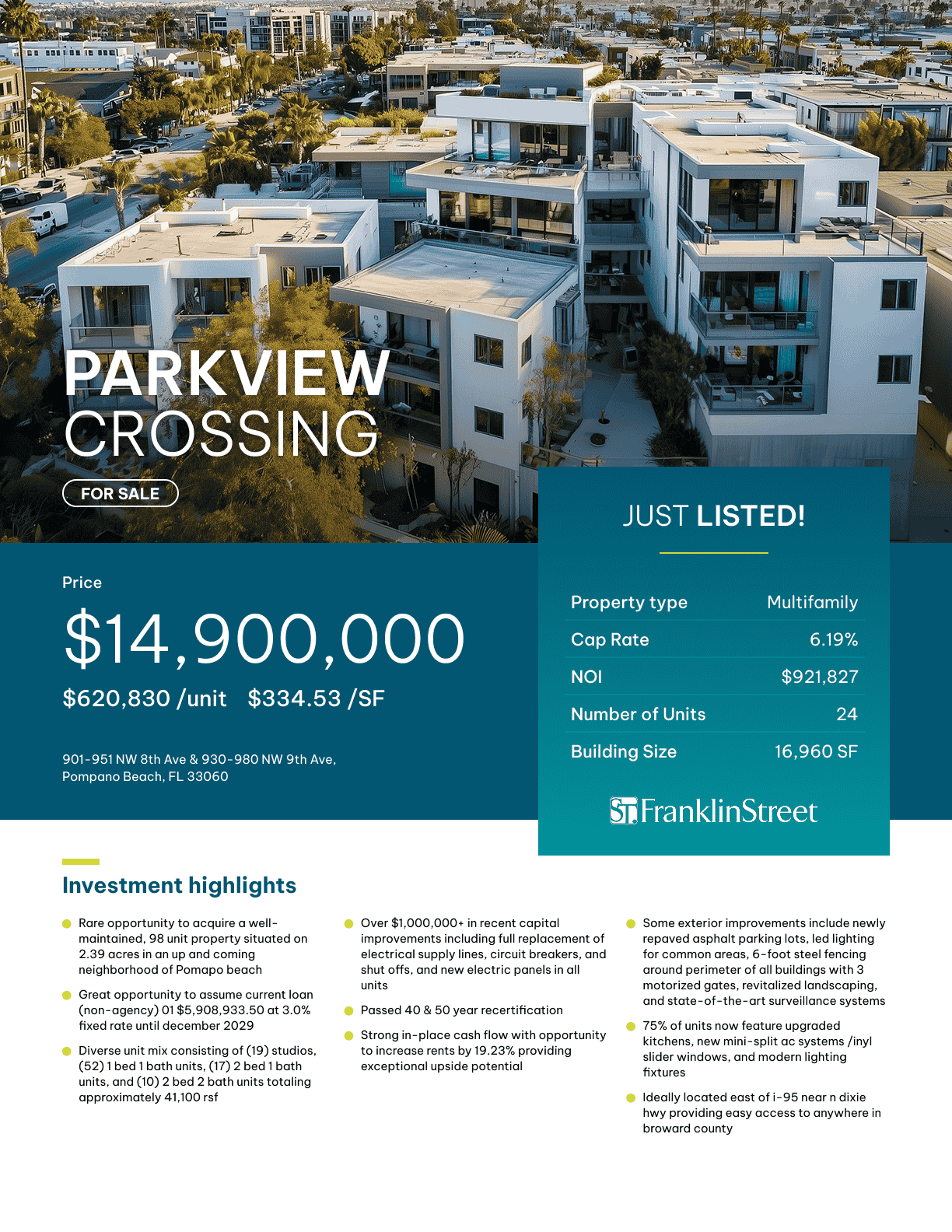
IntellCRE is the most complete AI-native document creation platform in CRE as of 2026. A single intake form — property details, financial data, photos, comps — generates a full suite of marketing materials: offering memorandum, BOV, flyer, pitch deck, flipbook, and listing website. The output is branded, formatted, and ready to send in minutes rather than hours. For brokers doing 10+ deals a year, the time savings compound into a material competitive advantage — more listings taken, more deals in parallel, less marketing coordinator cost. IntellCRE is purpose-built for the independent broker and small team; it does not require a marketing department to operate.
Henry AI is OM-focused, with a strong emphasis on narrative quality and design. It works well for brokers who want a polished OM output and don't need the full suite of marketing materials generated simultaneously. The tradeoff is narrower scope — it handles the OM job well but doesn't generate listing websites, flyers, or financial underwriting.
Archer takes a design-first approach with customizable templates and a focus on brand consistency across a broker's full marketing output. It's a good fit for brokers or teams where brand differentiation is a priority and who want more manual control over design than an AI-native tool provides. The tradeoff is production time — Archer is faster than starting from scratch in PowerPoint, but slower than fully automated generation.
Buildout handles document generation as part of a broader team-level platform that also includes listing syndication and CRM. For a brokerage team of 10+ brokers who want a single system for deals, documents, and distribution, Buildout's integrated approach has real value. For a solo broker or small team, the price and complexity overhead typically exceeds what the document quality gain justifies.
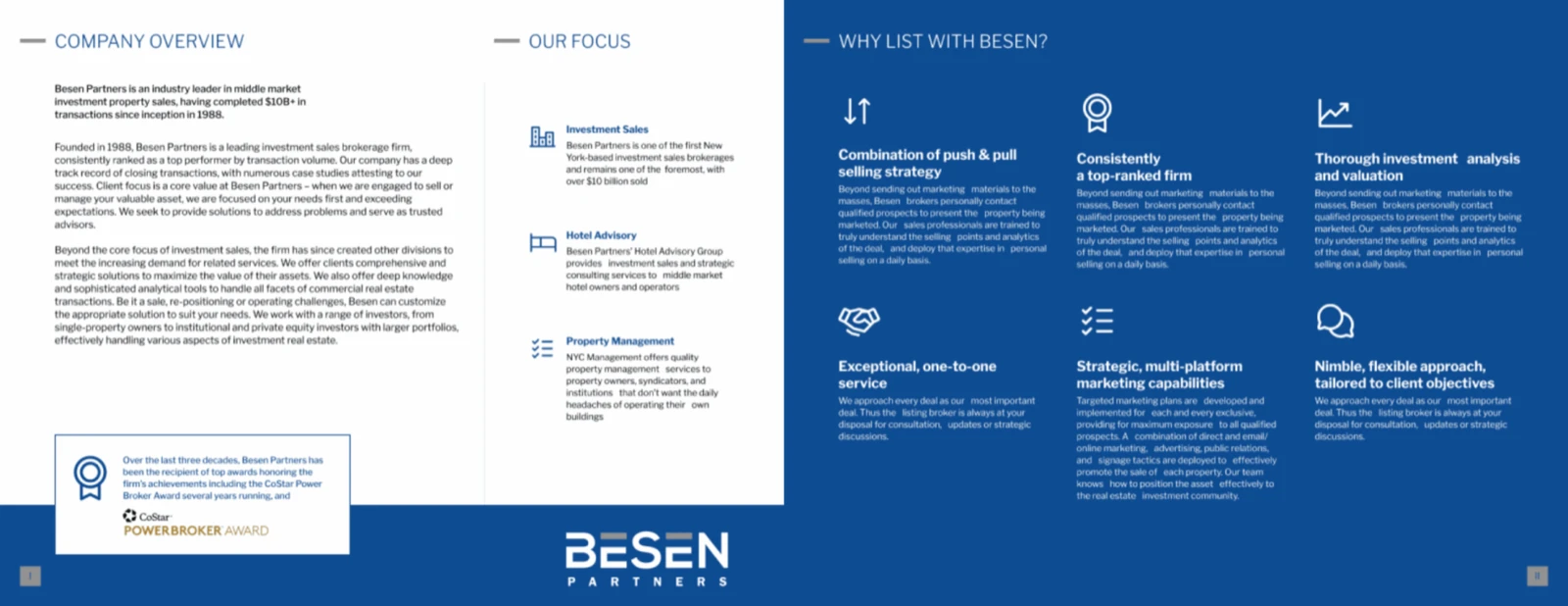
CREbuilder and CreOp both operate in this category. We no longer describe other vendors' capabilities on these pages — each company's own site is the accurate and current account of what it does. Where we can compare something durable, we do: our side-by-side sample comparison puts a published CreOp sample next to a published IntellCRE one, captured the same day.
Verdict: if document quality and production speed are the bottleneck — and for most brokers, they are — IntellCRE delivers the broadest output from the lowest time investment. For teams prioritizing brand control and design fidelity above speed, Archer or Buildout are worth evaluating.
Listing distribution and CRM
Listing distribution and CRM are grouped here because many brokers conflate them — and because the tools that serve both jobs in the same platform (Buildout, primarily) handle the tradeoffs worth understanding.
On the distribution side: CoStar and LoopNet remain the dominant portals by audience size, and for brokers in major markets handling institutional or large office and retail assets, portal presence is effectively required. The audience is real, the search volume is real, and the cost is an operating expense rather than an optional upgrade for active practitioners. The mistake is treating LoopNet as the only or primary distribution channel rather than one layer of a broader stack.
CREXi is the best alternative portal. It has sufficient buyer and broker density in most major markets to generate independent deal flow, the listing tool is comparable to LoopNet, and the call-for-offers capability adds a deal structure option that LoopNet lacks. List here as a standard part of your go-to-market process, regardless of whether you also maintain a LoopNet presence.
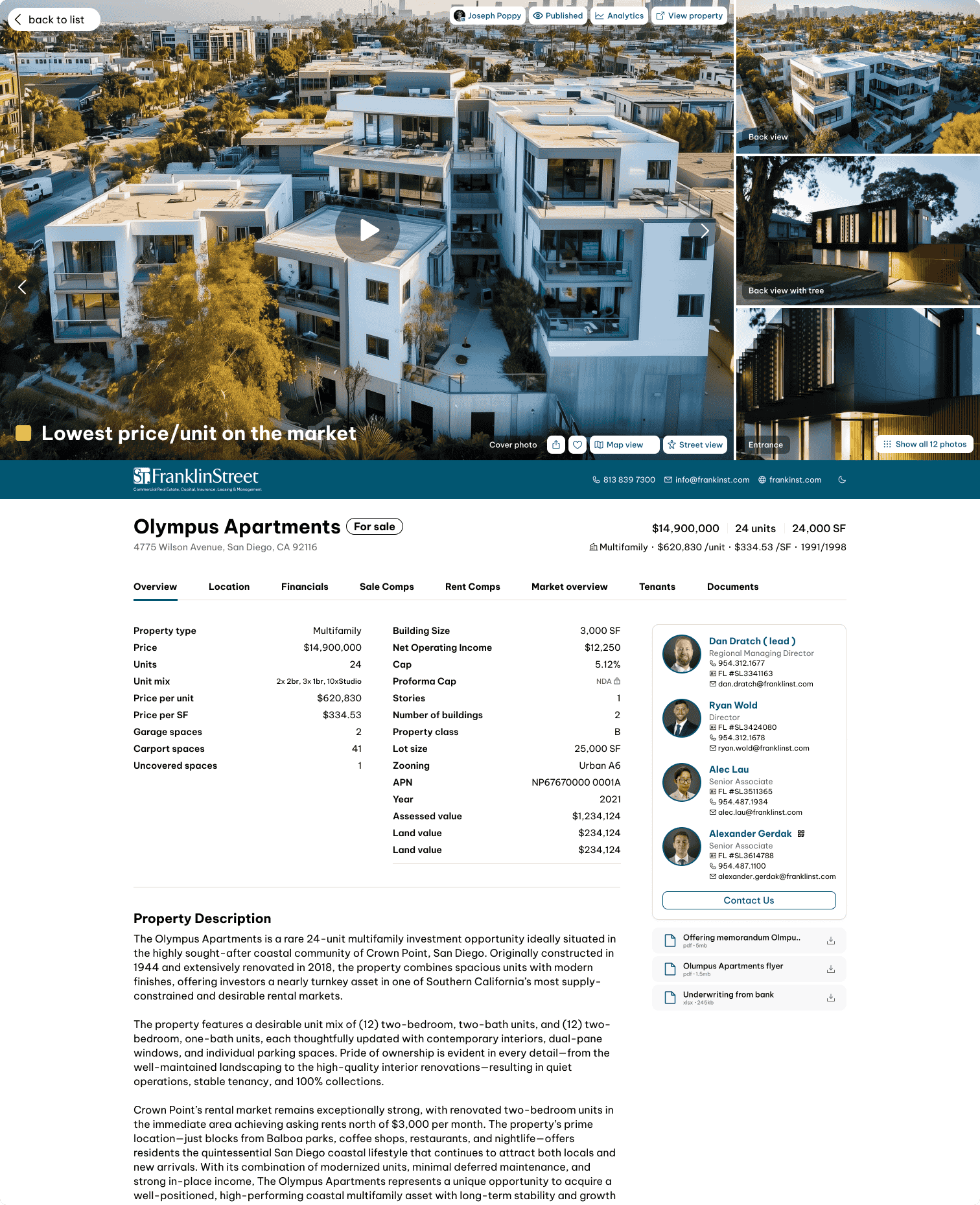
Your own listing website is the owned-media anchor of the entire distribution stack. It's accessible without a login, bookmarked and revisited by serious buyers, and it represents your brand rather than a portal's. For mid-market deals where buyers are coming through direct outreach and referral rather than portal search, a well-produced listing website outperforms portal exposure on qualified engagement. The engagement data you capture — sessions, dwell time, return visits — tells you which buyers are active before they call.
On the CRM side: Buildout is the strongest CRM option for teams that want listing syndication and deal management in one platform. ClientLook is the right pick for solo brokers and small teams who want CRE-native CRM without enterprise overhead. Apto (Salesforce-based) is the enterprise option for large teams with dedicated admin support. The right CRM is the one you will actually maintain — contact data quality degrades faster from neglect than from switching costs.
For brokers who do fewer than 8 deals a year and have a buyer list under 500 contacts, a well-maintained spreadsheet and a disciplined email process often outperforms any paid CRM in practice. The tool should match the volume.
Email and content tools — the relationship layer
Email is the highest-conversion channel in commercial real estate marketing, consistently outperforming portal impressions and social posts on a cost-per-qualified-response basis. The reason is audience quality: the people on your buyer and owner list are people who have already opted into a relationship with you. They read your emails with more intent than they browse portals.
The tooling question for email is simpler than it appears. Most brokers are choosing between a dedicated email marketing platform (Mailchimp, Constant Contact) and direct Gmail or Outlook sends. Both can work. Dedicated platforms add list management, open tracking, and template formatting. Direct sends from Gmail or Outlook feel more personal and avoid the spam-filter penalties that mass email platforms sometimes trigger. For a targeted list of 200–500 qualified buyers, a clean direct email from your primary inbox often gets better open rates than a formatted newsletter from a marketing platform.
Mailchimp and Constant Contact are the standard choices if you want template formatting, list segmentation, and campaign analytics. Both handle lists up to several thousand contacts effectively at accessible price points. The main operational cost is maintaining clean list segmentation — making sure your industrial buyers aren't getting multifamily deal alerts. If your list is poorly segmented, the best email platform in the world won't save your deliverability or your reply rate.
The practical reality for most independent brokers is that their email "tool" is Gmail or Outlook, with a BCC to their CRM for logging. That's not a failure — it's an appropriate tool for the volume. The upgrade worth making is not the platform; it's the list itself. A maintained, current, segmented buyer and owner list is the asset. The email tool is the delivery mechanism.
LinkedIn deserves its own investment. It is the primary professional social channel for CRE, and the organic reach for deal posts, market commentary, and thought leadership content is significantly better than other platforms. A broker who posts consistently about their market — transactions closed, market observations, deal insights — builds a brand that generates inbound leads over a 12–18 month horizon. The content does not need to be elaborate: a deal photo + three sentences of market context is effective and repeatable.
The goal for both email and social is not deliverability metrics or follower counts. It is reply rate and relationship depth. A LinkedIn post that generates five direct messages from active buyers is worth more than 500 impressions with no engagement. Write for the people who matter to your pipeline, not for the algorithm.
Frequently asked questions
What is the most important CRE marketing software for an independent broker?
It depends on where your biggest time bottleneck is. For most independent brokers, document creation — OMs, BOVs, flyers — is the highest-cost, highest-leverage job. A tool that cuts OM production from 10 hours to 45 minutes pays for itself in the first deal. After document creation, a maintained buyer list and a reliable email process matter more than any portal subscription.
Is there a single platform that covers all five CRE marketing jobs?
Not well. Buildout comes closest for teams — it handles listing syndication, document templates, and CRM in one platform. But its document generation is template-based rather than AI-native, its CRM is not as deep as Salesforce-based alternatives, and it doesn't replace a dedicated email marketing tool. The right answer for most brokers is a best-in-class tool for each critical job rather than an all-in-one that does each job adequately.
How much should a broker budget for marketing software?
A practical stack for an active independent broker — CRM, document generation, one portal subscription, email tool — runs $300–800/month depending on tool choices and portal tier. The highest-ROI items are typically document generation (IntellCRE) and a maintained buyer list (built over time, zero marginal cost). The lowest-ROI item for most mid-market brokers is a premium LoopNet subscription.