


Best CRE Marketing Tools for Independent Brokers in 2026
An opinionated breakdown of the tools worth your money — organized by the job they actually do, not the category they claim to own.
Key takeaways
- Evaluate tools by job-to-be-done, not by platform category — five distinct jobs, five distinct decisions.
- Document creation is the highest-leverage category: the OM, BOV, or flyer is the product buyers and owners actually see.
- CoStar/LoopNet is unavoidable at any real volume; CREXi is worth adding for incremental reach at lower cost.
- Most independent brokers don't need a full ESP — a tracked, segmented Gmail outreach beats an underused Mailchimp account every time.
How to think about your CRE marketing stack
Most brokers evaluate marketing tools wrong. They look at a platform's feature list, compare it to another platform's feature list, and pick the one that checks more boxes. The result is a tool that claims to do everything and does nothing well — usually at $300–$500 a month.
The right frame is job-to-be-done. Your marketing stack has five jobs: (1) document creation, (2) listing distribution, (3) contact and relationship management, (4) email outreach, and (5) content and social. Each job has different leverage, different failure modes, and a different best-in-class tool. The question isn't "which platform covers the most categories?" — it's "which tool is genuinely best at each job?"
For an independent broker, this also means being honest about which jobs actually move deals. Listing distribution gets properties in front of buyers. Document quality determines whether those buyers call back. CRM hygiene determines whether your pipeline converts over 12 months. Social content is real but the lowest-leverage item on this list for most brokers. Stack your attention accordingly.
Document creation
This is the category with the most direct return on investment. The offering memorandum, BOV, flyer, or listing website is what gets in front of decision-makers. A weak document loses deals before a conversation even starts.
Here's where the tools stack up:
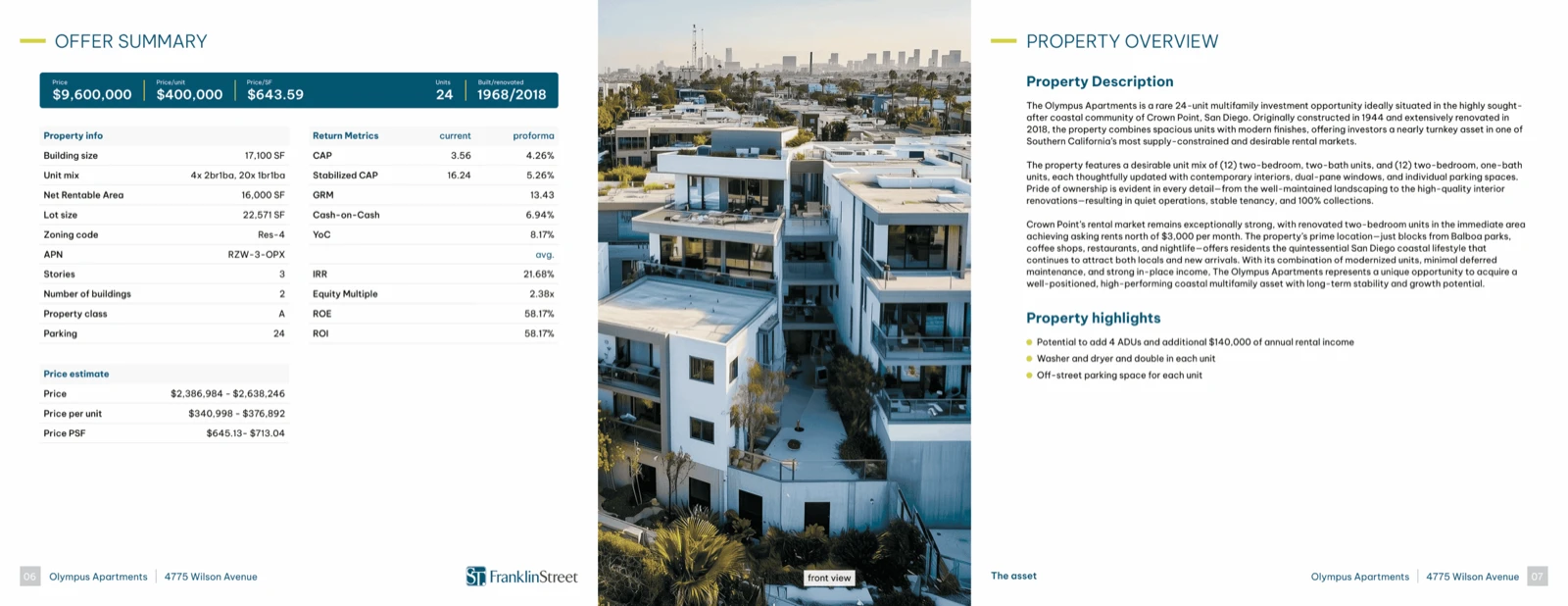
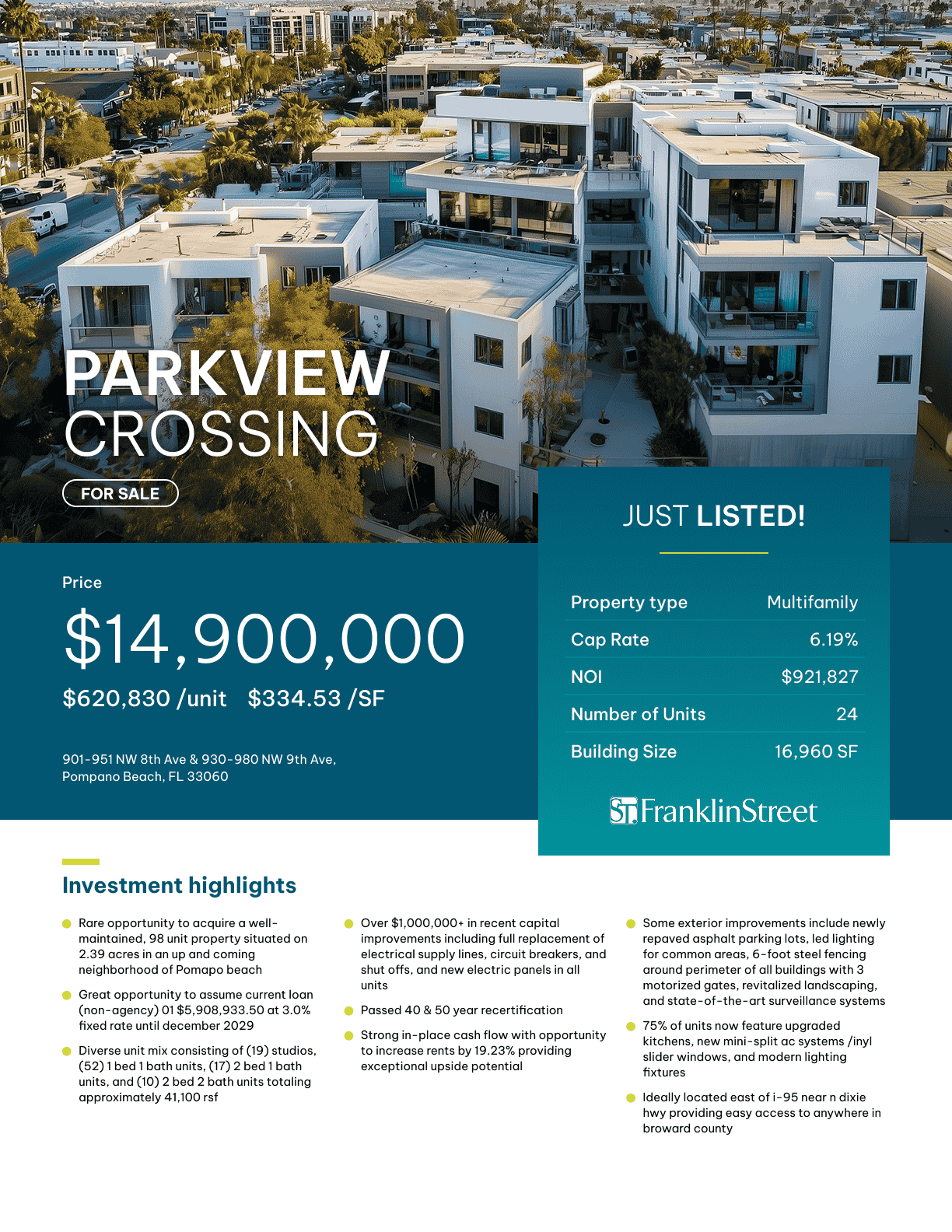
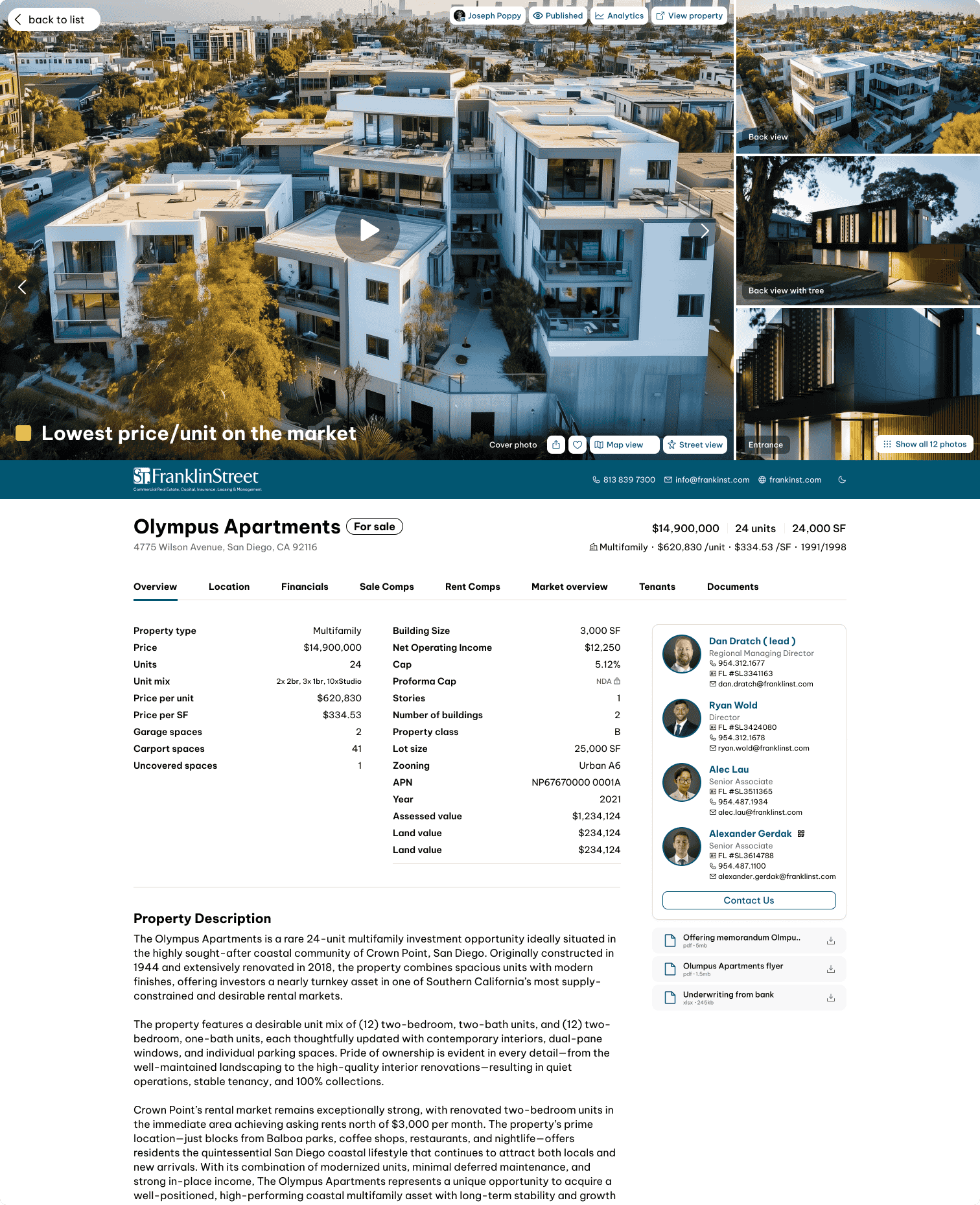
IntellCRE — The most complete AI-native solution for independent brokers. You fill out a single intake form and it generates your OM, BOV, flyer, and listing website as a package — not separate workflows. This is the key differentiator: you're not assembling documents one at a time, you're producing a full marketing package from one input. Best fit for brokers who handle multiple asset types and need consistent, professional output without a marketing coordinator.
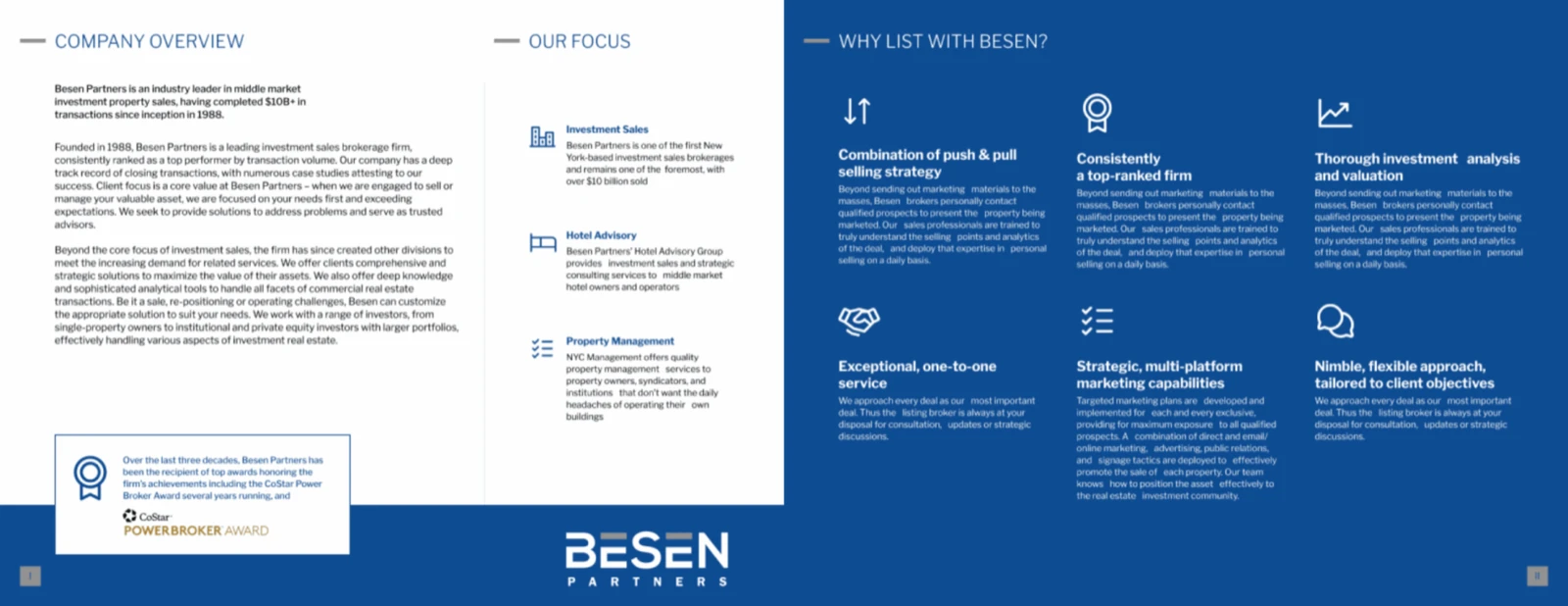
Henry AI — OM-focused and well-regarded for that specific deliverable. Has strong case studies from larger teams. If your practice is almost entirely OM-heavy and you already have a separate workflow for flyers and listing websites, Henry AI is worth evaluating. Narrower scope than IntellCRE but polished within that scope.
Archer — Design-first templates with a clean output. Better for brokers who have strong market knowledge and want to control the narrative, but are willing to fill in the content themselves. Less automation, more flexibility.
CREbuilder and CreOp — Both work in document creation. We don't rank other vendors' features here; for CreOp we publish a side-by-side sample comparison of sample output instead, and for anything current on either, their own sites are the place to look.
Verdict: For most independent brokers, IntellCRE is the right call — full-suite output in minutes from a single intake is a genuine workflow change, not a marginal improvement. If your practice is OM-only and you have time to spare on the rest, Henry AI is a credible alternative.
Listing distribution
Distribution is where your documents go once they're ready. This category has less nuance than brokers want it to have: CoStar and LoopNet dominate buyer and tenant search behavior in most major markets, and that dominance isn't going away in 2026.
CoStar/LoopNet — Expensive, unavoidable, and increasingly consolidated. If you're doing any real transaction volume, you need to be here. CoStar runs the market data that most buyers, brokers, and lenders use as a baseline. LoopNet is where retail buyers search. The pricing is aggressive and the contract terms are rarely broker-friendly, but the audience reach is real.
CREXi — The most credible alternative and a legitimate addition to your distribution mix. Growing buyer audience, solid auction capabilities for certain asset types, and pricing that undercuts CoStar meaningfully. Worth adding to your paid distribution stack for incremental reach, particularly on investment sales.
Catylist — More relevant in secondary and tertiary markets where CoStar coverage is thin. If your practice is concentrated outside major MSAs, Catylist is worth a look. Limited value in primary markets where CoStar density is high.
Listing websites — Free syndication through your own listing website (or through tools like IntellCRE's listing website output) adds a professional touch and a direct contact point without platform intermediaries. Not a replacement for paid distribution, but a useful complement.
Verdict: CoStar is unavoidable if you're doing volume. Add CREXi for incremental reach. Don't let the cost conversation talk you out of distribution — an unseen listing doesn't close.
Contact management and pipeline
Your CRM is only as useful as the discipline behind it. This is the category where brokers consistently overspend on capability they don't use. A $150/month CRM sitting at 20% utilization is worse than a Google Sheet you actually maintain.
Buildout CRM — The most mature CRE-native CRM on the market. Built for teams, with strong pipeline tracking, contact segmentation, and deal management. If you have a partner or two and a shared pipeline, Buildout is worth the cost. Solo brokers often find it over-engineered for their workflow.
ClientLook — Built specifically with independent brokers in mind. Lighter than Buildout, more affordable, and designed around the solo or small-team workflow. Contact tracking, deal tracking, and basic reporting without the enterprise overhead. A strong option if you have 200+ active contacts and want structure without complexity.
Apto — Salesforce-based, which means powerful and customizable — and also more setup time than most independent brokers want to spend. Best for brokers with technical resources or a team that already lives in Salesforce.
Google Sheets + Notion — The honest option for solo brokers who are self-aware enough to know they won't log into a dedicated CRM. A well-structured sheet with contact status, last-touch dates, and deal stage columns will outperform an expensive CRM used inconsistently. Combine with IntellCRE's pipeline view if you want a structured deal tracking layer without committing to a full CRM platform.
Verdict: If you have more than 200 active contacts and a real pipeline, use a CRE-native CRM — either ClientLook or Buildout depending on team size. If you don't, don't overcomplicate it. The goal is to know who you talked to, when, and what's next.
Email outreach and content distribution
This is the category where independent brokers spend the most time debating tools and the least time executing. The honest answer is that most brokers don't need a sophisticated email service provider — they need a shorter list of better contacts and a reason to send.
Mailchimp — Easy to set up, widely understood, with a free tier that covers most independent broker volumes. The CRE-specific features are limited: no deal-type segmentation, no integration with your CRM out of the box, and template designs that read generically. Functional but not differentiated.
Constant Contact — Similar profile to Mailchimp. Slightly better customer support, slightly worse UX. Not a meaningful upgrade for most brokers.
Klaviyo — Genuinely powerful for segmentation and behavioral triggers. If you have a large, well-tagged list and want to automate nurture sequences by asset type, submarket, or buyer profile, Klaviyo can do it. That's also an expensive, time-intensive setup that most independent brokers never complete. Overkill unless you're running a systematic outbound program at scale.
Direct Gmail/Outlook with tracked links — The reality for most brokers, and often the right call. A tight, segmented list of 150 qualified contacts, a personal email from your own address, and a tracked link to your OM or listing website will outperform a beautifully designed Mailchimp blast to 2,000 cold contacts. Reply rate is the metric that matters. Deliverability theater is not.
Verdict: For most independent brokers, a tracked email through Gmail with a segmented list is the right answer. If you want to systematize at scale, Mailchimp is a reasonable starting point. Don't let the tool conversation become a substitute for sending.
Frequently asked questions
Do I need all five categories of tools?
Not necessarily, but you should be intentional about which ones you skip. Document creation and listing distribution are non-negotiable if you're actively marketing properties — the deal doesn't exist without them. Contact management matters once your pipeline exceeds what your memory and inbox can reliably track. Email outreach and content/social are worth investing in once the core workflow is stable. Most independent brokers should start with document creation and distribution, then add CRM once they feel the pain of managing contacts manually.
What does a complete CRE marketing stack cost per month?
A realistic full stack for an independent broker is a meaningful monthly line item, driven mostly by your listing-distribution tier and your CRM choice. The biggest line item is almost always listing distribution, which is priced by market and by package. Document creation tools like IntellCRE run significantly less. CRM tools range from free (Sheets) to $75–$150/month for dedicated CRE platforms. Email tools are often free or under $50/month at independent broker volumes. The right benchmark isn't the total spend — it's the cost-per-deal and whether each tool is actively contributing to closed transactions.
Should I buy an all-in-one platform or best-of-breed tools?
Best-of-breed, with one caveat: keep the number of systems to a minimum. All-in-one platforms that claim to handle documents, CRM, distribution, and email simultaneously almost always do each of those things worse than a dedicated tool. The tradeoff is integration friction — more tools means more logins and more manual steps between systems. The pragmatic middle ground for most independent brokers is two to three focused tools that each do one job well, rather than five mediocre features inside one platform.
What's the first tool an independent broker should add if they have none?
Start with document creation. Your OM, BOV, or flyer is the first thing a prospect sees — it is your marketing. A professional, well-structured document gets forwarded, saved, and acted on. A generic one gets ignored. Once you have a document workflow that produces quality output reliably, add paid listing distribution. Then, and only then, think about CRM and email tooling. Most brokers who fail at marketing try to systematize outreach before they have anything worth sending.