
CRE Content Repurposing Templates
Ready-to-use formats for turning one deal, one OM, or one market observation into content across LinkedIn, email, and outreach — without starting from scratch each time.
Key takeaways
- Every closed deal contains at least three pieces of reusable content — a LinkedIn post, an owner prospecting email, and an investor update. The Content Calendar Guide shows how to schedule all three so they go out in the right sequence.
- Lead with market insight, not self-congratulation — posts and emails that share what the deal tells you about the market outperform announcement-style content.
- Your OM investment thesis is already written — extract it, reformat it for LinkedIn, and you have a high-signal post in under 10 minutes.
- A quarterly recap sent to your full list with real data keeps you top-of-mind without a single hard pitch.
Deal close post — publish within 48 hours of close, lead with insight not congratulations
[One-sentence market signal this deal proves — e.g., "Suburban flex industrial in [Submarket] is pricing tighter than most people think."]

We just closed [Asset Type] at [Address or Cross Streets], [City].

[2–3 sentences of deal context: asset class, size, condition, why it was interesting. No price required.]

What this deal tells me about [Submarket]:

[One specific market insight — a cap rate observation, a buyer profile shift, a supply constraint, something real.]

If you own [Asset Type] in [Submarket] or you're looking for more deals like this — I'd like to talk.

DM me or drop a comment. More coming.

---

FILLED EXAMPLE:

Suburban office-to-industrial conversions are closing faster than stabilized product in the South Valley right now.

We just closed a 28,000 SF flex/office building on Thornton Ave, San Jose — vacant at listing, three offers by week two.

The buyers weren't local. Two came from out-of-state 1031 exchanges chasing yield they couldn't find in their home markets.

What this tells me about South Valley: the lack of quality small-bay industrial is pushing buyers toward conversion plays that would have sat two years ago.

If you own under-utilized flex or office product in this corridor, now is a better time to test the market than most people realize.

DM me if you want to talk through what your asset might do.
Market intel post — extract one surprising insight from your OM or BOV data
[Hook: one surprising or counterintuitive stat from your OM or BOV data — make it specific.]

Here's what's driving it:

[2–3 sentences explaining the underlying cause — vacancy trends, buyer demand, supply constraints, rent movement.]

What it means for owners and investors in [Submarket]:

[One clear implication — is it a window to sell, a signal to hold, a reason to look at adjacent submarkets?]

[Question to invite engagement, or DM invite — e.g., "Curious what your asset looks like against this data? Reply or DM me."]

---

FILLED EXAMPLE:

Average cap rate compression in East Oakland industrial dropped 40 bps in Q1 — without a single new lease comp driving it.

Here's what's driving it: buyer competition for sub-50,000 SF product has outpaced available inventory by a ratio we haven't seen since 2021. Institutions are bidding on deals they would have ignored three years ago, pushing private buyers to stretch on price.

What it means for owners in East Oakland: the spread between "what you think it's worth" and "what a buyer will pay today" is wider than most recent appraisals suggest.

Own industrial in this submarket? I'd like to show you where your asset sits in the current data. DM me.
Owner prospecting email — repurpose a recent close as a comp for neighboring owners
Subject: I just sold [Asset Type] near your property

Hi [First Name],

I recently closed [Asset Type] at [Address], about [Distance] from your property at [Their Address].

[One sentence on what the deal revealed — buyer demand, pricing, speed of sale.]

Given how similar your asset is, I thought you'd want to know where the market is pricing comparable product right now.

Worth a 10-minute call if you're curious what it means for yours.

[Your Name]
[Brokerage] | [Phone]
Investor re-engagement — use a recent close to prove activity and tease pipeline
Subject: We just closed [Asset Type] in [Submarket] — here's what's next

Hi [First Name],

Quick update: we closed [Asset Type] in [Submarket] last week. [One sentence on deal outcome — strong pricing, fast execution, competitive offers.]

What the deal tells us about what's coming to market: [One forward-looking observation — motivated sellers, repricing in adjacent submarkets, 1031 demand, etc.]

We have [X] deals in various stages of pipeline right now. Happy to walk you through what fits your criteria.

Worth a call this week?

[Your Name]
[Brokerage] | [Phone]
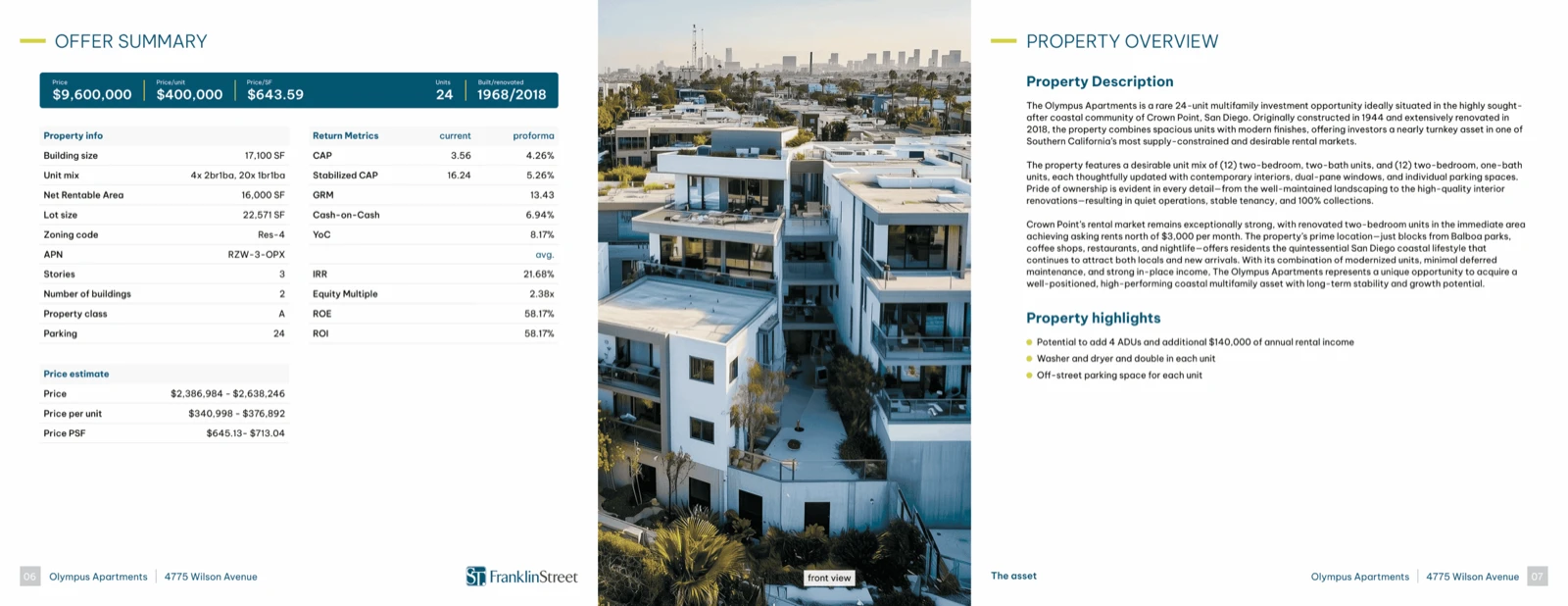
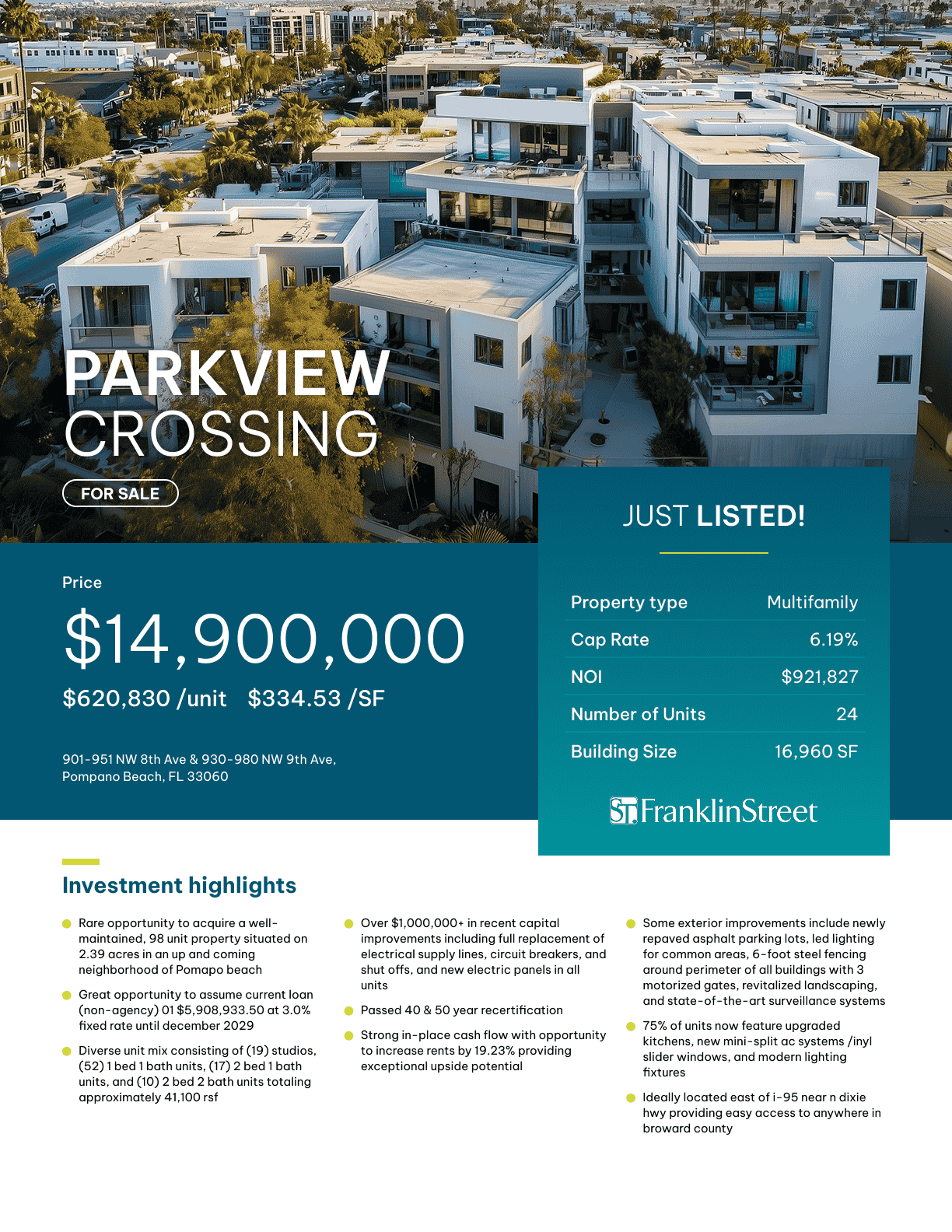
OM-to-LinkedIn — pull the investment thesis from your OM and make it a post
STEP 1 — Pull this paragraph from your OM:
[Paste your OM's investment thesis or "opportunity overview" section here — usually 3–5 sentences describing why the asset is compelling.]

STEP 2 — Apply this post structure:

[Hook: your OM's single strongest claim, rewritten as a direct statement — not "the property offers" but "this asset does X"]

Three things that make this deal worth looking at:
• [Highlight 1 — financial or occupancy metric]
• [Highlight 2 — location or demand driver]
• [Highlight 3 — upside or value-add angle]

[One market insight that gives this deal context — why now, why this submarket, why this asset class]

[CTA — DM invite, link to OM, or "reply if you want details"]

---

FILLED EXAMPLE:

BEFORE (OM language):
"The subject property presents a rare opportunity to acquire a stabilized, NNN-leased industrial asset with a strong credit tenant in a high-barrier-to-entry submarket with limited competitive supply and significant rent growth potential over the remaining lease term."

AFTER (LinkedIn post):

A 12-year NNN lease with a credit tenant in a submarket where industrial vacancy is sitting at 2.1% — this is the kind of deal that doesn't come back once it's gone.

Three reasons this one is worth your attention:
• 100% occupied, 12 years remaining, annual escalations built in
• Located in a last-mile distribution corridor with no new supply under construction
• Below-market rent creates a mark-to-market story at rollover

The South Bay industrial market is still absorbing faster than it's adding inventory. That window doesn't stay open indefinitely.

Full OM available — DM me or comment below.
Quarterly market recap — send to your full list, leads with data not listings
Subject: [Submarket] market recap — Q[X] [Year]

Hi [First Name],

Here's a quick read on where [Submarket] stands heading into Q[X+1].

WHAT CLOSED THIS QUARTER
[2–3 sentences: notable transactions, asset classes, pricing signals. You don't need to name every deal — name the trend.]

WHAT THE DATA IS TELLING US
[2–3 sentences: vacancy, cap rates, absorption, or rent movement — one or two specific numbers, not a spreadsheet.]

WHAT I'M WATCHING IN Q[X+1]
[1–2 sentences: a trend, a seller type, a capital source, or a pricing shift you expect to see in the next 90 days.]

WHAT'S IN MY PIPELINE
[1–2 sentences: general pipeline activity — asset types, submarkets. No addresses required. This is a proof-of-activity signal, not a listing blast.]

If any of this connects to something you're working on, I'd like to hear about it. Reply here or call me at [Phone].

[Your Name]
[Brokerage]
Frequently asked questions
How soon after a deal closes should I publish the LinkedIn post?
Within 48 hours is ideal — deal energy is highest, memory is fresh, and the insight is still timely. For the offering memorandum investment thesis that becomes your best post, IntellCRE generates it at intake so it's ready to repurpose before the listing even goes live. If you miss that window, reframe it as a recent market data point rather than a breaking announcement. The insight still has value; just lead with the market observation rather than "I just closed."
Do I need to include the sale price in any of these templates?
No. Price is optional in all of these. Cap rate, buyer profile, days on market, and competitive dynamics are often more useful signals for your audience — and they don't require disclosing confidential terms. Lead with what the deal tells the market, not what it paid.
How do I use these templates if I haven't closed a deal recently?
Use your BOV or OM data instead of a closed deal. Any market analysis you've done for a pitch contains real data — vacancy rates, comparable sales, rent trends. The market intel post (Template 2) and the OM-to-LinkedIn template (Template 5) work without a closed transaction. Your research is content.
How often should I send the quarterly recap?
Once per quarter to your full list. Think of it as your highest-leverage send of the year — it reaches owners and investors who haven't heard from you in months, demonstrates market knowledge without a pitch, and generates replies from people who are quietly ready to move. Don't skip it because you think the market has been slow. Slow markets have data too.
Can I use these templates for multiple asset classes?
Yes — every template is asset-class agnostic. Simply fill in the brackets with the specific asset type (industrial, multifamily, retail, office, self-storage) and submarket. The structure holds across property types. If you cover multiple asset classes, consider running each template separately for each class to keep the audience targeting tight.