
How to Create a CRE Offering Memorandum That Actually Wins Listings
Most OMs are data dumps. The ones that win listings are written like pitch decks — they tell a story that pre-answers objections before the buyer asks.
Key takeaways
- The cover and executive summary of your OM are the only pages most buyers read first — they determine whether the rest gets opened.
- Lead with the investment thesis, not the address. The story frames everything that follows.
- Rent roll, T-12, and proforma should appear in a sequence that builds confidence — not all at once.
- Your OM distribution strategy is as important as the document itself. A great OM with no launch plan is just a PDF.
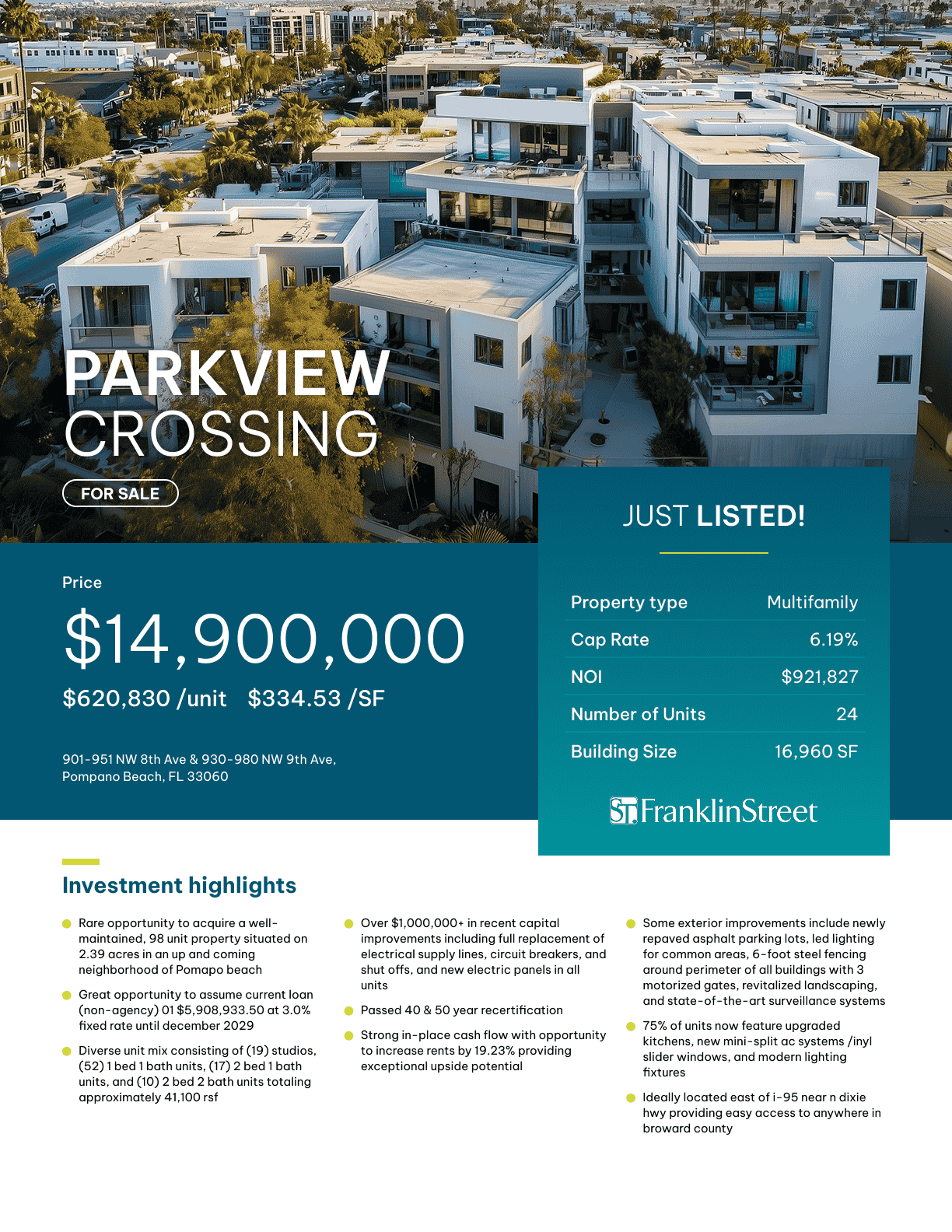
Why most OMs lose before they're read — the first-page problem
The average buyer principal spends under 90 seconds on an OM before deciding whether to forward it to their analyst or close the tab. That decision is made almost entirely on the cover and the first half of the executive summary. If those pages don't answer "why this deal, why now" with a clear, confident voice, the rest of the document never gets read.
Most OMs fail this test for the same reason. They open with the property address, the asset class, and a photo — and then spend two paragraphs describing the location in the most generic possible terms. "Located in a high-demand submarket with strong fundamentals" tells a buyer exactly nothing. It signals that the broker hasn't done the work to develop a real point of view on the asset.
The first-page problem is also a positioning problem. If your OM looks and reads like every other OM in that buyer's inbox, you've already lost the differentiation battle. Buyers see dozens of OMs a month. The ones that get forwarded to partners, printed, and physically set aside are the ones that open with a specific, credible argument — not a data table.
The fix is simpler than most brokers think: write the executive summary last, after you've built out the full deal story. Once you know every angle of the thesis, the financials, and the market position, you can distill it into a first page that reads like conviction rather than catalog copy. Test it with a colleague who doesn't know the deal — if they can't tell you the investment case in 30 seconds after reading the first page, rewrite it.
The investment thesis: leading with the story, not the address
The investment thesis is the single most important paragraph in your OM. It answers the question every buyer is actually asking: why should I own this property, and why should I buy it now? Address, square footage, and year built don't answer that question. A specific argument about value does.
A strong investment thesis has three components. First, it identifies the asset's primary value driver — stable cash flow, lease-up upside, below-market rents, land value, or something else specific to this deal. Second, it connects that driver to a market or submarket dynamic that makes the timing relevant. Third, it tells the buyer what the exit looks like — and why it's realistic.
"Strong in-place cash flow with below-market rents on a triple-net lease to a nationally-branded tenant in a supply-constrained retail corridor, with 18% rental upside at the next lease event in 2028" is a thesis. It's specific, it's defensible, and it creates a mental image of the investment journey. Compare that to "well-located retail asset with stable tenancy" — which describes approximately 80% of active listings.
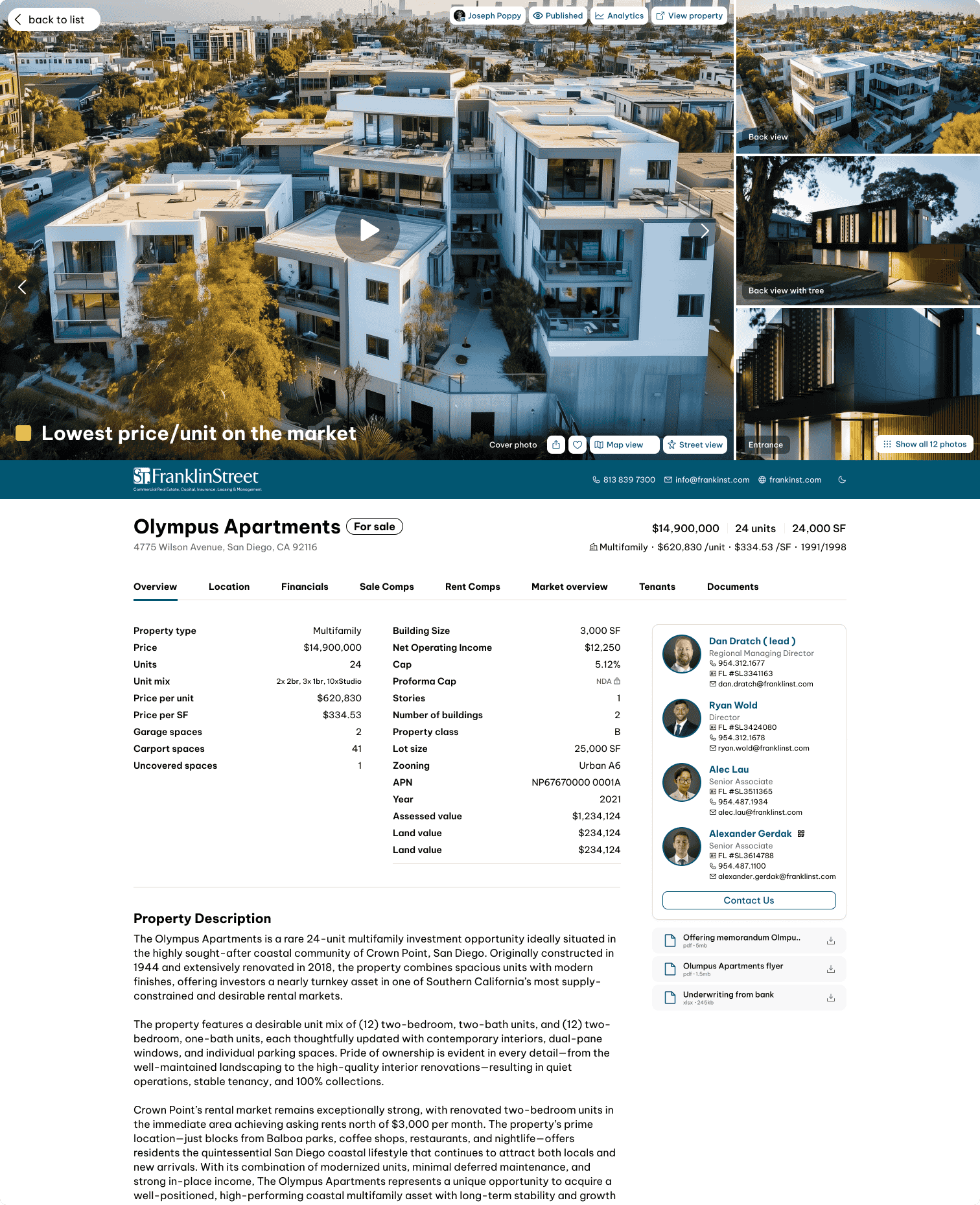
For a step-by-step guide to creating your OM in IntellCRE, the thesis section is where you earn the buyer's trust before they've seen a single number. If a buyer reads your thesis and thinks "I need to know more," your OM is doing its job.
Write the thesis in one to three sentences. Read it out loud. If it sounds like something you could say in a pitch meeting without reading from notes, it's ready. If it sounds like a legal description, rewrite it.
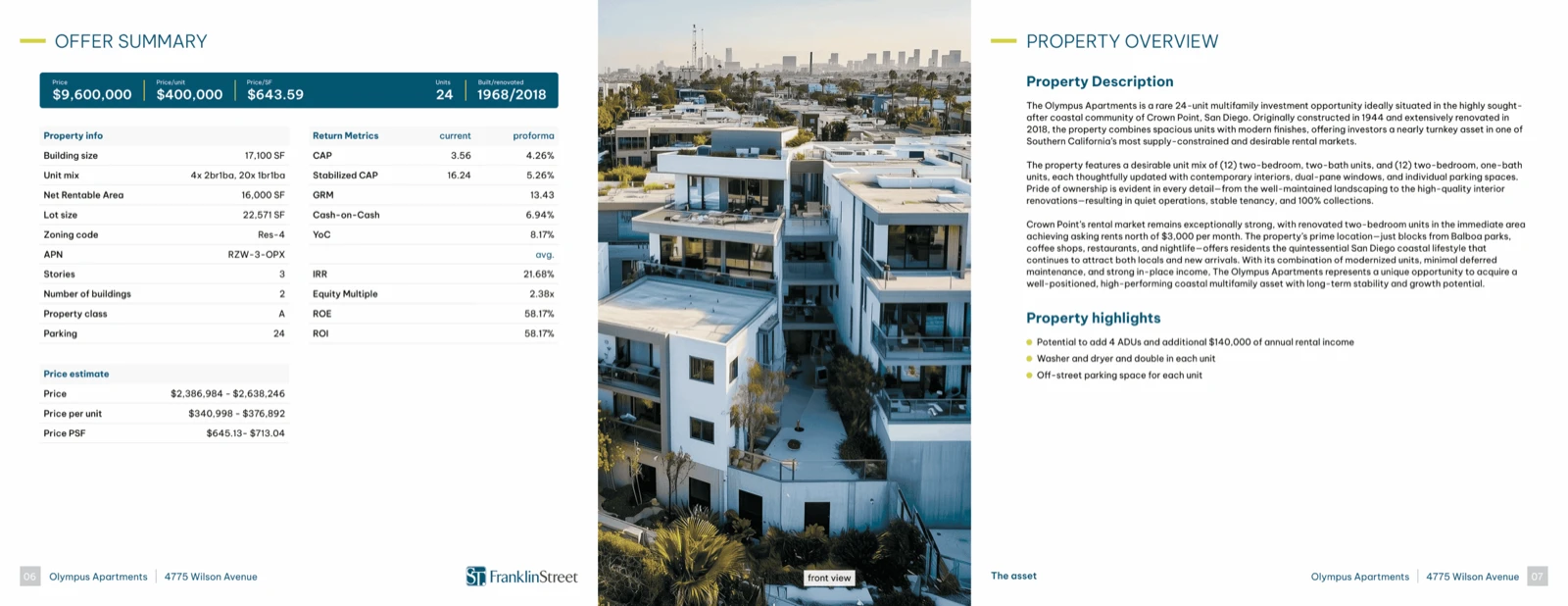
Financials that build confidence: rent roll, T-12, proforma in the right order
The order in which you present financial data is not a formatting decision — it's a persuasion decision. Each financial exhibit should answer the next logical question a buyer has after reading the previous one.
Start with the rent roll. The rent roll establishes what is actually in place today — who is paying, how much, under what lease terms, and when those leases expire. It's the foundation. Before a buyer will trust any projection, they need to know the current state is stable and documented.
Move to the T-12 after the rent roll. The trailing twelve months of income and expenses validates the rent roll — it shows that the rents being collected match what's on paper, that expenses are consistent, and that there are no anomalies in the income stream. A clean T-12 that matches the rent roll is one of the most confidence-building things you can show a buyer before they get to projections.
Present the proforma last. By the time a buyer reaches the proforma, they've already accepted the rent roll and the T-12 as accurate — which means your assumptions have a foundation to stand on. A proforma floating above no verifiable actuals looks like wishful thinking. The same proforma sitting on top of a clean rent roll and a verified T-12 reads like a credible forecast.
For property analysis in IntellCRE, this sequencing is built into the output structure. Whether you're building the OM manually or generating it automatically, the discipline of rent roll → T-12 → proforma will make your financials substantially easier for a buyer to trust — and substantially harder for a skeptical analyst to pick apart.
One more rule: every proforma assumption should be footnoted. If you're assuming 3% annual rent growth, say so. If you're assuming a 10% vacancy reserve, show it. Unexplained assumptions invite substitution — buyers will fill in their own numbers, and they're usually more conservative than yours.
Market context that demonstrates submarket expertise (not generic market commentary)
Market sections are where OMs go to die. The typical market section is three pages of charts pulled from a CoStar PDF, a paragraph about the metro area, and a claim about "robust demand drivers" that could apply to any market in the country. Buyers skip it. Brokers know this. And yet the same template gets used again on the next deal.
The purpose of a market section is not to prove that the market exists — buyers know where your deal is. The purpose is to demonstrate that you know this submarket with the precision of someone who works it every day. That's a very different brief.
Submarket expertise looks like: knowing the vacancy rate by block, not just by zip code. Knowing which tenants have been looking at the corridor for 18 months and haven't committed yet. Knowing that the anchor tenant two blocks over just signed a 10-year extension, which signals confidence in foot traffic. These are the facts that a buyer in San Francisco or New York cannot get from a research report — and if you can give them those facts, you've just become the most credible person in the transaction.
Cut the metro-level charts. Keep submarket-specific data, and add a brief qualitative "broker's perspective" paragraph that synthesizes what you see on the ground. Three sentences of genuine submarket insight outperform three pages of demographic tables every time.
Bring that same specificity to your comparable transactions. Don't just list comps — interpret them. If a comparable sold at a 5.5 cap and your deal is priced at 5.75, explain why: longer WALT, larger average unit, or a more institutional-quality tenant mix. The offering memorandum that wins listings is the one that treats every section as an argument, not just a data exhibit.
The distribution strategy: an OM without a launch plan is a document, not a campaign
You can write the best OM in the history of your market and still lose the listing if you don't have a distribution strategy. Distribution is where most CRE marketing breaks down — not because brokers don't know how to send emails, but because they treat the OM as the endpoint instead of the centerpiece of a coordinated campaign.
A real distribution strategy has four layers. First, targeted outreach to your first-tier buyer list — the active buyers you know, sorted by fit with this specific deal type, deal size, and submarket. This list should be personalized, not a blast. Second, broker-to-broker outreach to the three to five buyer's brokers you know are currently active in this product type. These calls happen before the OM goes out to anyone else — relationship first. Third, the wider market blast through your email platform, with a subject line built around the investment thesis, not the address. Fourth, listing portals, which are table stakes but not where deals actually get sourced at this price point.
Time the release. Launch the OM on a Tuesday or Wednesday. Friday distributions get buried. Monday distributions compete with the week's incoming load. Set a call-for-offers date in the cover email — it creates urgency and signals a professionally managed process, which itself signals that there are other buyers in the market.
Track who opened and who didn't. Follow up with buyers who opened but haven't responded within 48 hours. Non-response from a known buyer often means they're interested but cautious — a phone call converts more of those than a second email.
The brokers who consistently win listings understand that the document is only half the product. The campaign is the other half.
Frequently asked questions
How long should a CRE offering memorandum be?
For most deals, 20–35 pages is the right range. Below 15 pages and the OM looks underprepared. Above 45 pages and buyers stop reading. The discipline is knowing which data earns its place and which is filler. An OM that's 28 tight pages beats a 50-page data dump every time.
What's the difference between an OM and a BOV?
A BOV (Broker Opinion of Value) is your pricing argument — it's what you bring to an owner meeting to win the listing. The OM is what you produce after you have the listing. A BOV says "here's what we think it's worth and why." The OM says "here's everything a buyer needs to make an offer."
Should the asking price appear in the OM?
Only if you're running a stated-price process. If you're running a best-offer or call-for-offers process, use a cap rate guidance range rather than a hard price. A stated price anchors buyers at your number; a cap rate range gives sophisticated buyers room to self-select and often produces higher offers.
How do I handle a deal with messy financials in the OM?
Get ahead of it. If there are vacancies, deferred maintenance, or an unusual expense line, address it in the narrative rather than hoping buyers won't notice in the T-12. Buyers find everything. An OM that acknowledges a challenge and frames it as upside reads as credible. An OM that buries a problem reads as deceptive — and tanks the process when it comes out in due diligence.