
Best CRE Offering Memorandum Templates (Free and Paid) in 2026
A frank assessment of every OM template option — from free downloads to full automation — and which ones are actually worth a broker's time.
Key takeaways
- Templates solve the design problem — they do not solve the content problem.
- Free templates work if you already have a strong writer and design instincts; most brokers do not, consistently.
- Paid tools cut design time but leave the hardest hours untouched: writing the investment thesis, pulling market data, and building clean financials.
- If you close 20 deals a year, template-based OMs cost you roughly two full work weeks annually — before you account for revision cycles.
Why most OM templates fall short
An offering memorandum has two distinct problems, and most brokers conflate them. The first is design: pages that look amateurish, inconsistent fonts, photos that bleed into text, financials that are impossible to read on screen. The second is content: a weak investment thesis, missing submarket context, financials that don't tell a coherent story, and a narrative that fails to frame why this asset, at this price, deserves serious attention.
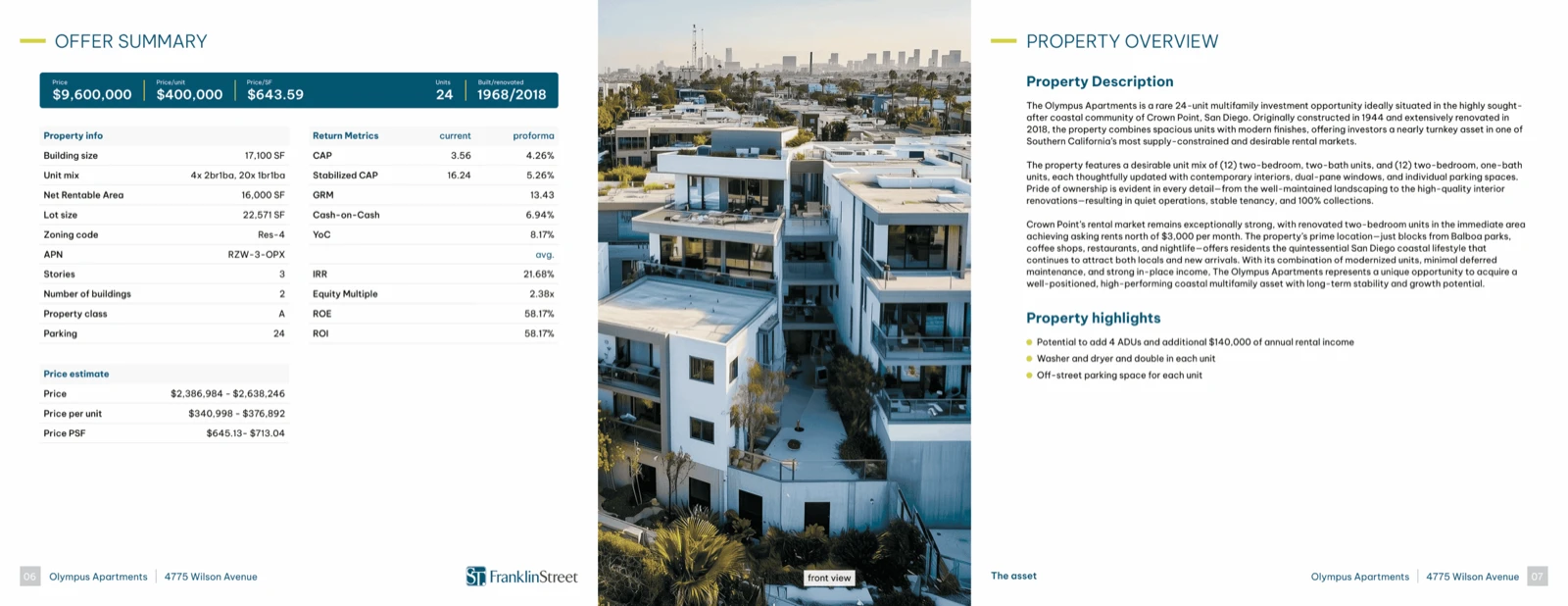
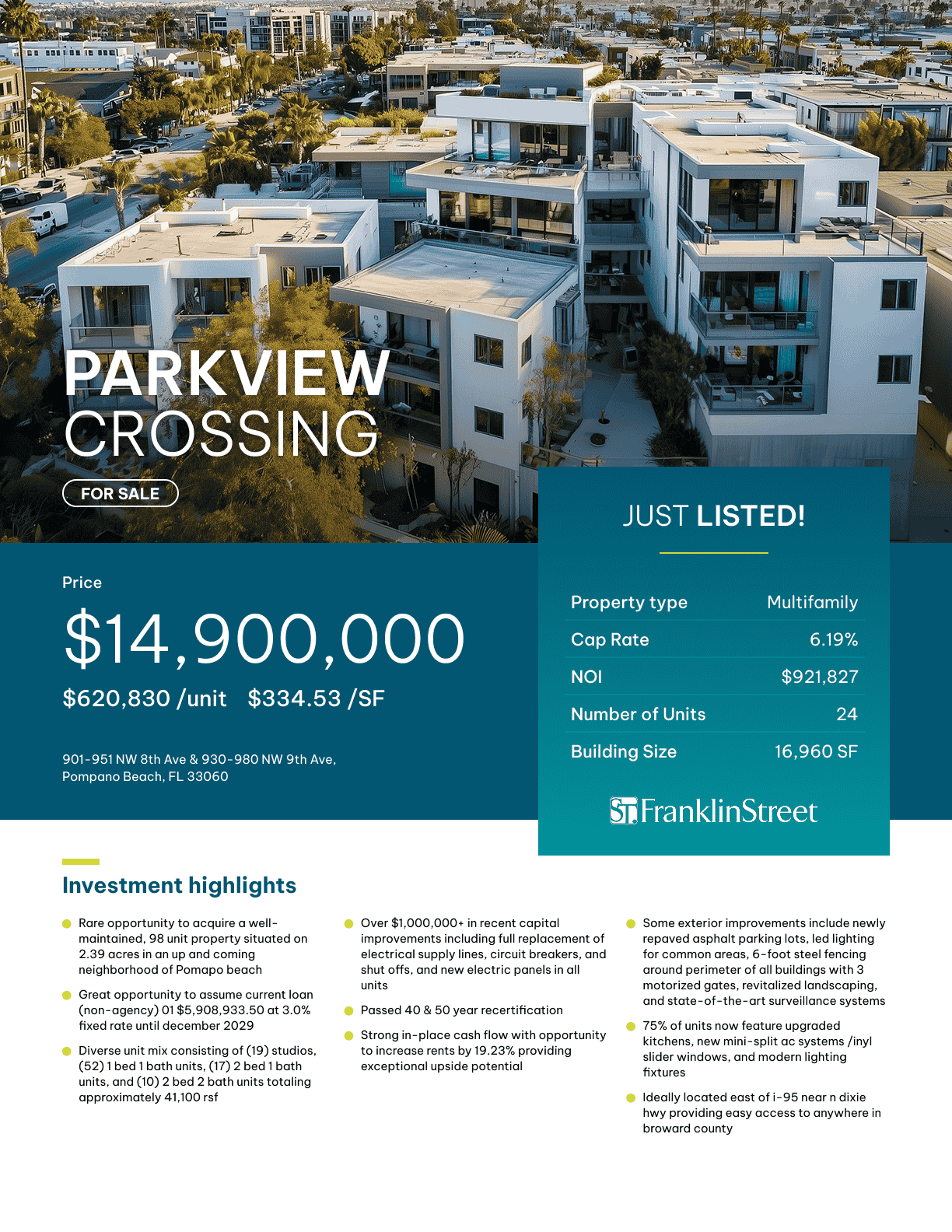
Templates — free or paid — address the first problem. A well-built template gives you a clean grid, a place for your cover photo, a consistent type hierarchy, and a financial summary layout that looks professional. None of that helps you write a compelling story about why a buyer should act.
The brokers who produce consistently strong OMs are not the ones with the best templates. They are the ones who have a clear point of view on the asset before they open any document — and who can transfer that point of view into persuasive language quickly. A template speeds up the last mile. It does not solve the first mile.
When you are evaluating any template option, hold it against two questions: Does it force me to write a real investment thesis, or does it let me skip it? Does it give me a logical flow for financials — rent roll, T-12, proforma on consecutive pages — or does it scatter them? Most templates fail both tests. A few pass the first. Fewer still pass both.
Free OM templates worth using
Free options are more useful than most brokers expect, as long as you go in with clear eyes about what you are getting.
CoStar basic OM format. CoStar's deal-page export is the most widely recognized baseline format in the market. It is not a design template — it is a data-forward layout with property details, location map, and basic financials. Its ubiquity is its main value: buyers know how to read it, which reduces friction. It will not win you a listing on presentation alone, but it won't embarrass you on a stabilized small-cap deal where buyers are buying the numbers, not the story.
CBRE and JLL public deal packages. You cannot download a CBRE or JLL template, but their publicly available deal packages — surfaced through CoStar, LoopNet, or direct broker relationships — are the best free benchmarks available. Pull three or four from your market and submarket. Study the cover page hierarchy, the financial summary layout, the market section depth, and the CTA structure. These are not templates to copy; they are calibration tools. They tell you what institutional-quality looks like in your asset class.
Google Slides and PowerPoint community templates. The CRE-specific templates circulating on Slidesgo, SlidesCarnival, and various broker forums range from passable to genuinely useful. The best ones give you a clean grid for the cover, a two-column financial layout, and a map placeholder. The worst ones are generic pitch deck templates with "Real Estate" dropped into the title. Filter ruthlessly: if it does not have a dedicated rent roll page and a market section, it is not an OM template.
Reddit CRE community shared templates. The r/CommercialRealEstate and r/realestateinvesting communities periodically share working OM templates, usually built in PowerPoint or Google Slides by working brokers. These are unpolished but practical — built by people who have actually had to populate them under deadline. Search the subreddits for "OM template" and sort by top posts. You will find three or four genuinely useful starting points.
Verdict. Free templates work if you have a strong writer on your team and enough design sense to customize without breaking the layout. Most brokers have neither consistently — especially across a full pipeline. Use free templates on smaller deals, lower-stakes listings, and situations where speed matters more than differentiation. Do not use them for your highest-profile listings.
Paid OM template tools
Paid tools add two things free templates cannot: better design defaults and, in some cases, light collaboration features. What they do not add is the content.
Canva Pro CRE templates. Canva's CRE template library has improved substantially. You will find multi-page OM layouts with clean cover page options, financial table placeholders, and photo grids that actually work. The design quality is above average. The limitation is that every field is manual — you are typing or copy-pasting every number, every submarket stat, every line of the investment thesis. Canva Pro is a low monthly subscription. For a solo broker doing five to eight deals a year, it is a defensible spend if design is your main gap. It is not a production tool for a high-volume team.
Xtensio. Xtensio is a SaaS document builder designed for business proposals and pitch decks. It is not CRE-specific, and that gap is noticeable — there are no rent roll modules, no T-12 layouts, no submarket data placeholders. What it does well is collaborative editing and version control, which matters if you have a marketing coordinator or an assistant involved in production. If your OM process is breaking down at the handoff stage, Xtensio is worth a look. If your OM process is breaking down at the content stage, it will not help.
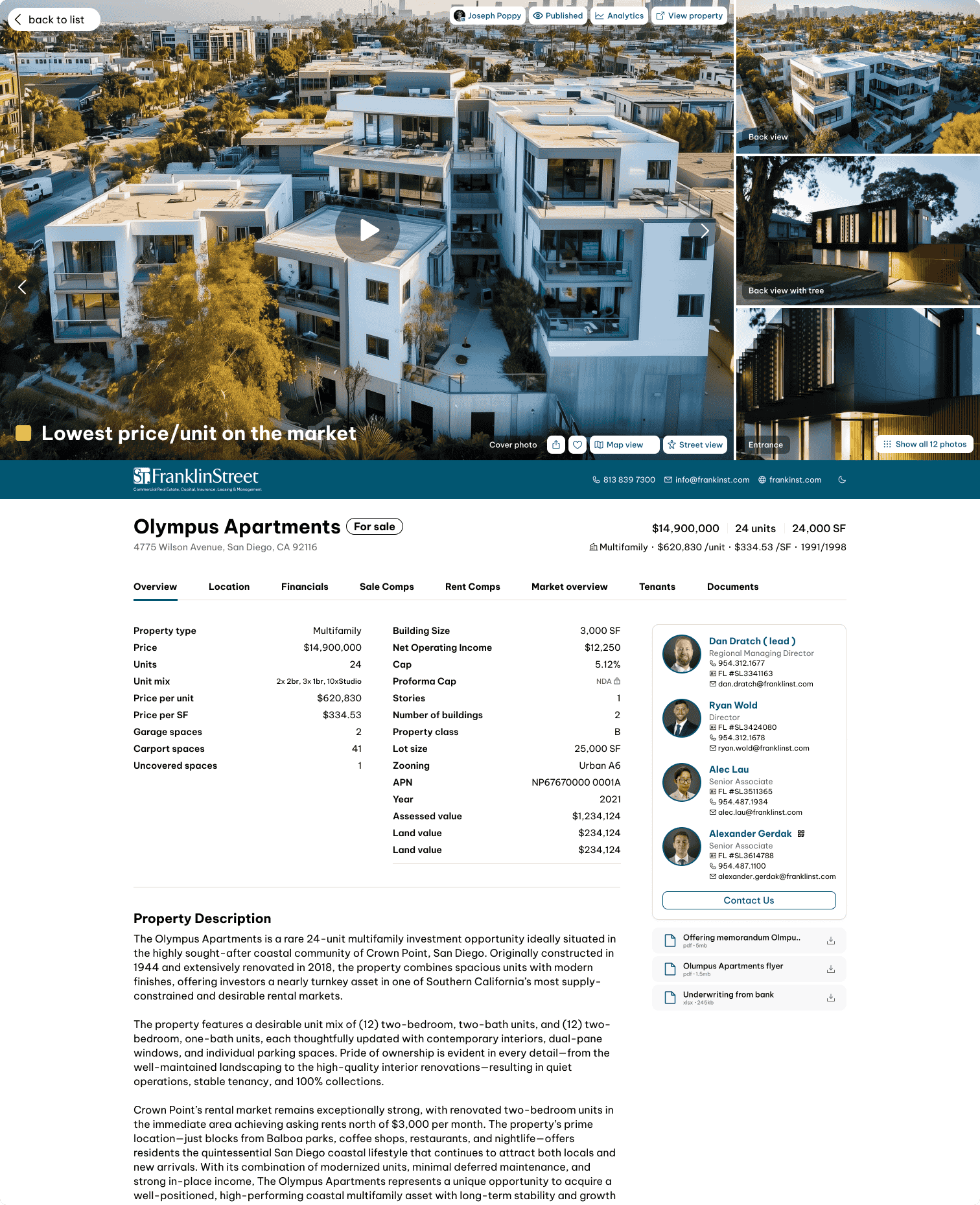
CreXi OM builder. CreXi's built-in OM builder is portal-native, which means your OM lives on the platform and distributes through it. That is a real advantage for deal marketing workflow. The customization ceiling is low — you are working within CreXi's templates and branding guardrails, not building a fully branded document. For brokers already listing on CreXi who want a fast, serviceable OM without leaving the platform, it is a reasonable option. For brokers who care about brand differentiation, it is constraining.
Buildout. Buildout is the most mature paid option for teams. It is not just a template tool — it is a full brokerage marketing platform with OM generation, email campaigns, and pipeline tracking. The OM output is consistently professional, and the population is semi-automated from your listing data. The cost is meaningful (team pricing typically starts in the hundreds per month) and the onboarding investment is real. For larger brokerages producing 30 or more OMs a year, the math works. For solo brokers or small teams, the overhead may not.
Verdict. Paid tools reduce design time materially. The best of them — Buildout in particular — also reduce some population time through data sync. None of them write your investment thesis, pull your submarket cap rate trends, or frame the deal narrative. That hour is still yours.
When to move beyond templates entirely
Run the math on your own pipeline. If an OM takes four hours with a well-built template — cover, financials, market section, investment thesis, photography placement, final formatting pass — and you close 20 deals a year, that is 80 hours spent on document production. Two full work weeks, every year, before you account for revision cycles with clients or partners.
The revision cycle is where templates quietly destroy more time than brokers track. A client wants the proforma adjusted. The font weight does not match the brand refresh from last quarter. The market section needs a different submarket pull because the buyer profile shifted. Each of these is a 20-minute task in isolation. They compound.
The 101 Keys to Creating a Winning OM or BOV is a useful audit tool here — read it before you finalize any template workflow and ask honestly how many of those keys your current process reliably delivers. Most template-based processes hit 40 to 60 percent.
With IntellCRE's offering memorandum tool, the OM — investment thesis, financials, market data, and branded design — is generated from a single intake form in minutes, not hours. That is not a design shortcut. It is a content shortcut, which is the only shortcut that actually changes the math.
The elements every strong OM needs
These criteria apply regardless of which template or tool you use. Run any template against this list before you commit to it for a listing.
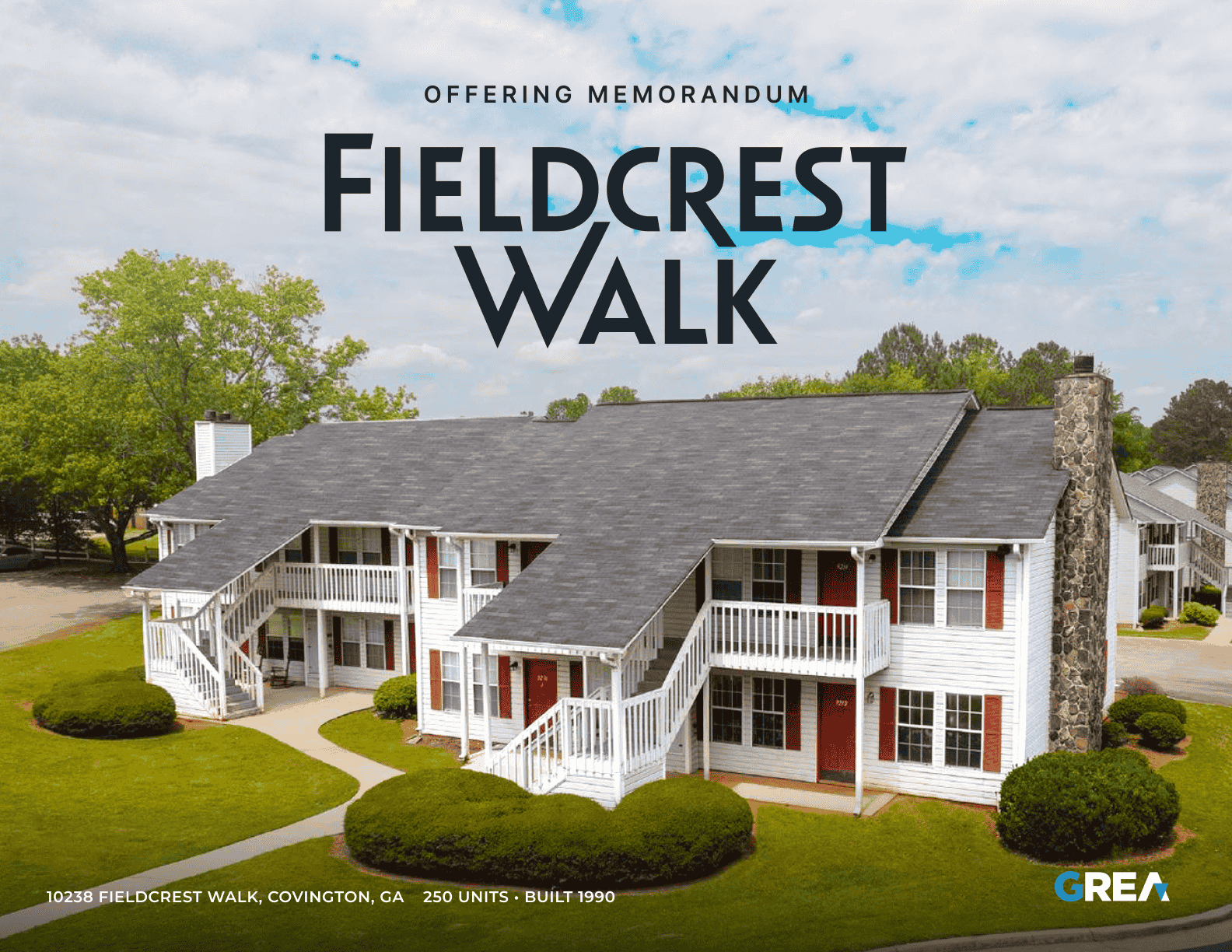
Investment thesis on page one. Not the property address. Not the broker's headshot. The thesis: what is this asset, why is it priced correctly, and what is the primary value driver for the buyer? If your template's page one is a photo and a tag line, you are starting the document with decoration instead of argument.
Clean financials in a logical sequence. Rent roll, T-12, and proforma should appear on consecutive pages in that order. Buyers read them as a set — current tenants, trailing performance, forward projection. Scattering them across a 40-page document forces buyers to work harder than they should, and they won't.
Submarket-specific market overview. Not metro-level vacancy stats. Submarket cap rate trends, comparable transactions from the last 12 months, and absorption data for the relevant property type. A generic market section signals that the broker did not do the work. Buyers notice.
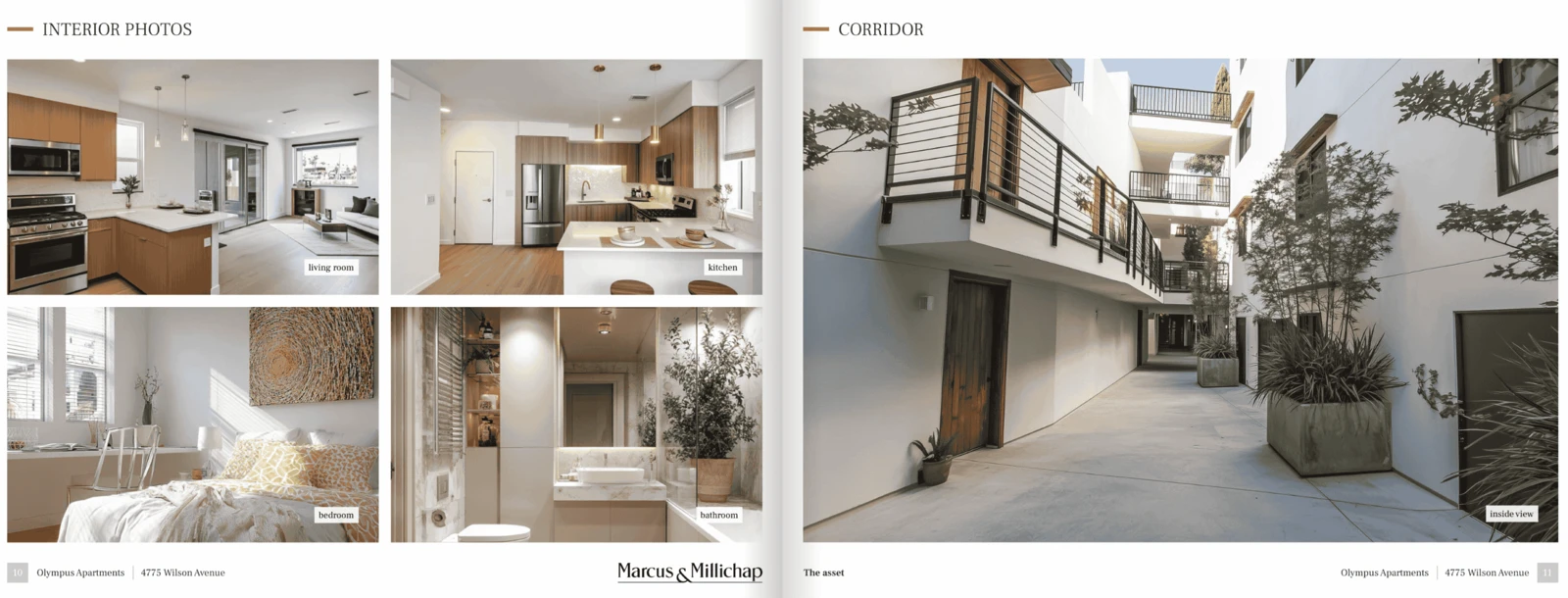
Professional photography. Exterior, interior, and aerial. This is not a design preference — it is a filtering mechanism. Poor photography signals poor asset presentation, which signals a broker who is not fully engaged in the deal. Photography quality is a proxy for broker quality in the buyer's first read.
A clear call to action. Offer deadline, process summary, contact information with direct phone and email. Make it impossible for a motivated buyer to not know exactly what to do next.
If the template you are evaluating does not have a logical home for each of these five elements, find a different template. They are not optional components of a strong OM — they are the OM.
Frequently asked questions
Can I use a free OM template for a $10M+ listing?
You can, but you should be deliberate about it. A free template on a $10M+ listing is only appropriate if you have a strong writer handling the investment thesis and market section, and someone with genuine design sense doing the final production pass. Institutional buyers evaluating an eight-figure asset will read the document quality as a signal about the broker's engagement and the seller's sophistication. A free template that has been rigorously populated and edited can outperform a premium template that has been lazily filled in — but on a listing at this price point, the bar for both content and design is higher than on a $2M deal.
What should an OM include that most templates leave out?
Three things consistently missing from template-based OMs: a real investment thesis (most templates have a placeholder headline but no structure for the actual argument), submarket-specific comparable transactions (most market section templates pull metro stats, not submarket comps), and a clear buyer profile framing (who is this asset right for, and why). Templates also routinely omit a debt assumptions page, which matters to leveraged buyers, and a clear explanation of the offering process — exclusive vs. open, offer deadline, tour process.
How long should an OM be?
For most asset types, 20 to 35 pages is the functional range. Below 20, you are likely missing submarket context or financial depth. Above 40, you are padding — which signals a broker who is not confident enough in the core story to be selective. The exceptions are large portfolio deals and complex mixed-use assets, where 50-plus pages can be warranted because the asset complexity genuinely requires it. As a rule: every page should earn its place. If you cannot explain in one sentence why a page is in the document, it probably should not be.
What's the difference between an OM and a BOV?
A BOV (Broker Opinion of Value) is a pre-listing document you prepare for a prospective seller to demonstrate your market knowledge and justify a listing price range. It is typically shorter — 8 to 15 pages — and focused on valuation methodology, comparable sales, and your competitive positioning as the listing broker. An OM is a buyer-facing document prepared after you have the listing, designed to market the asset to the broadest qualified buyer pool and drive offers. The audiences, purposes, and content structures are fundamentally different, even though both cover the property and the market.