


Best CoStar Alternatives for CRE Brokers in 2026
CoStar is a premium subscription priced by market and access tier. Here is how to get the data you actually need — and what to pair with it to build better marketing materials.
Key takeaways
- CoStar's real value is comps depth and market analytics — not listing distribution. Know what you're paying for before you cancel.
- PropStream and Crexi cover most ownership and listing data needs for less.
- CREXi is the strongest alternative to LoopNet/CoStar listing portals and is growing its buyer audience fast.
- CoStar is your research layer. IntellCRE is your production layer. The two jobs are different tools.
What CoStar actually does — and what brokers are really paying for
CoStar bundles several distinct products under one subscription, which is part of why it's expensive and part of why brokers struggle to evaluate it accurately. At its core, CoStar delivers four things: property comps (sale and lease), market analytics by submarket, ownership and tenant data, and listing distribution through LoopNet and CoStar's own portal.
The comps depth is CoStar's most defensible value. No public alternative matches the breadth and verification quality of CoStar's lease comp database in major markets. If you're doing office or retail work in a top-25 MSA and your deals depend on accurate lease comps for BOVs and appraisal support, this is genuinely hard to replace cheaply. Acknowledge that before you evaluate alternatives.
Market analytics — submarket vacancy, absorption, rent trends, inventory pipeline — is the second valuable layer. CoStar's analytics are institutional-grade and are updated frequently enough that you can cite them in pitch materials with confidence. The free alternative is CBRE, JLL, and Cushman & Wakefield quarterly market reports, which are genuinely useful for most pitch conversations but lag CoStar by a quarter and don't go down to the micro-submarket level.
The listing distribution piece — LoopNet exposure — is worth examining separately. Most brokers pay for CoStar primarily because it includes LoopNet. But LoopNet's audience is broad, not targeted, and the best buyers for most mid-market deals are people you already know or can find through CREXi and direct outreach. The portal fee buys exposure, not necessarily the right exposure.
Where CoStar loses value: ownership data (PropStream does this better for most use cases), single-tenant net lease comps in secondary markets (Crexi comps are competitive), and basic listing search (Crexi is free for this). Identify which CoStar features you actually open every week before you cut or downgrade.
Top CoStar alternatives for data and research
The honest answer is that no single tool replaces CoStar — but for most independent brokers, a combination of lower-cost tools covers 80–90% of the actual use cases.
PropStream is the strongest alternative for ownership data. It covers residential and commercial property records, ownership history, liens, and distressed indicators across the entire country. For brokers doing cold outreach to property owners — especially in industrial, multifamily, and single-tenant retail — PropStream is often more useful than CoStar's ownership module, which is priced into the higher tiers. Run owner lists, filter by equity position, and export to your CRM. The comps module is lighter than CoStar but workable for high-level BOV conversations.
Crexi has the most momentum as a CoStar data alternative. The free tier includes listing search and basic comp data across property types. The Pro tier gives you verified sale and lease comps, analytics dashboards, and ownership data that competes directly with CoStar for most deal types. Crexi's comp database in industrial and multifamily is now deep enough to stand on its own in many markets. Start with the free tier and upgrade only if you're regularly hitting the data walls.
Reonomy, now part of CoStar Group, focuses on ownership and tenant data with strong portfolio-view tools. It's genuinely useful for brokers who do a lot of prospecting to find who owns what — particularly for large portfolio holders and 1031 buyers. The catch: CoStar acquired Reonomy, so the pricing and integration strategy may shift.
Free institutional reports from CBRE, JLL, Cushman, and Colliers cover macro market intelligence for the largest 30–50 MSAs. For quarterly pitch conversations, these are credible and free. The limitation is granularity — they don't go to the submarket or micro-market level. Sign up for the research email lists of every major firm in your markets. Most publish free quarterly and annual reports that your clients will recognize by brand.
Verdict: for most mid-market brokers doing 5–20 deals a year, PropStream + Crexi Pro + free institutional reports covers most of what they actually use it for, for less. The gap is lease comp depth in major office and retail markets.
Top alternatives for listing distribution
CoStar's listing distribution value comes almost entirely from LoopNet. So the relevant question when evaluating CoStar alternatives for listing distribution is: what actually gets your listing in front of motivated buyers?
CREXi is the strongest LoopNet alternative for most property types. It has built a genuinely large buyer and broker audience, and its auction and call-for-offers feature gives it an edge for assets where competitive bidding drives price. More importantly, CREXi listings generate more qualifying data — buyer engagement metrics, time spent, document downloads — than LoopNet does. List on CREXi whether or not you stay on CoStar.
Catylist is worth knowing for secondary and tertiary markets where CoStar/LoopNet audience density drops. It has strong commercial MLS integration in the Southeast and Midwest and is widely used by local broker associations. If your deals are in markets under 500,000 population, Catylist may outperform LoopNet for local buyer exposure.
Brevitas serves the off-market and institutional end of the market. If you're representing NNN assets over $5M or institutional multifamily, Brevitas has a curated buyer audience that is more useful than broad portal exposure. It's positioned as a premium, lower-volume alternative.
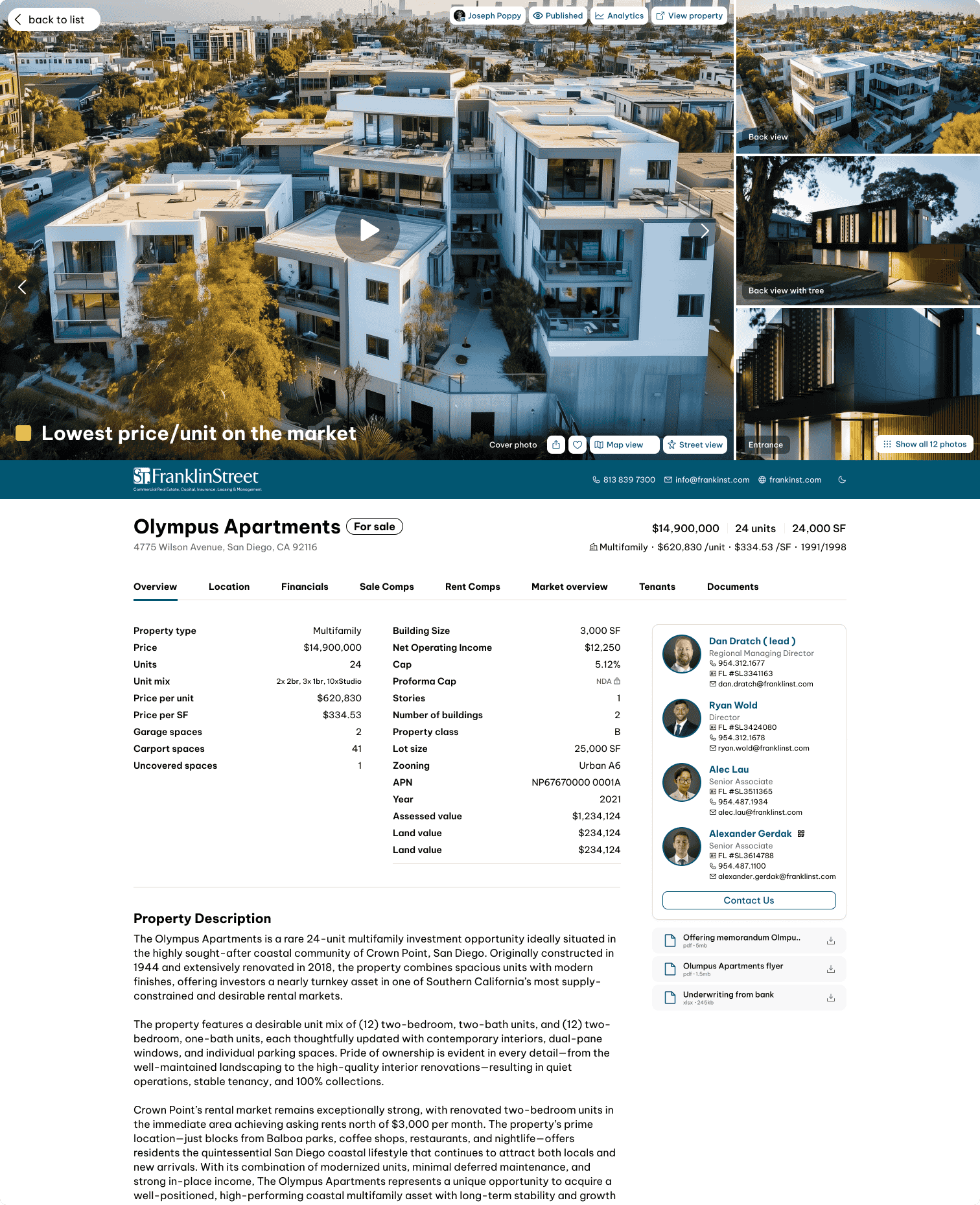
The highest-leverage listing distribution channel for mid-market deals is a dedicated listing website that you own and control. A property microsite is bookmarked, shared directly, and accessible without a paywall or portal login. Buyers revisit it as they do due diligence. It's the one distribution channel that doesn't put a portal's branding between you and your buyer. For brokers who send listings by email to a qualified buyer list, linking to your own site consistently outperforms linking to a LoopNet page.
Build your listing distribution stack as a complement: CREXi for broad reach, your own site for engagement depth, email to your buyer list for direct conversion.
How IntellCRE fits into a CoStar-light stack
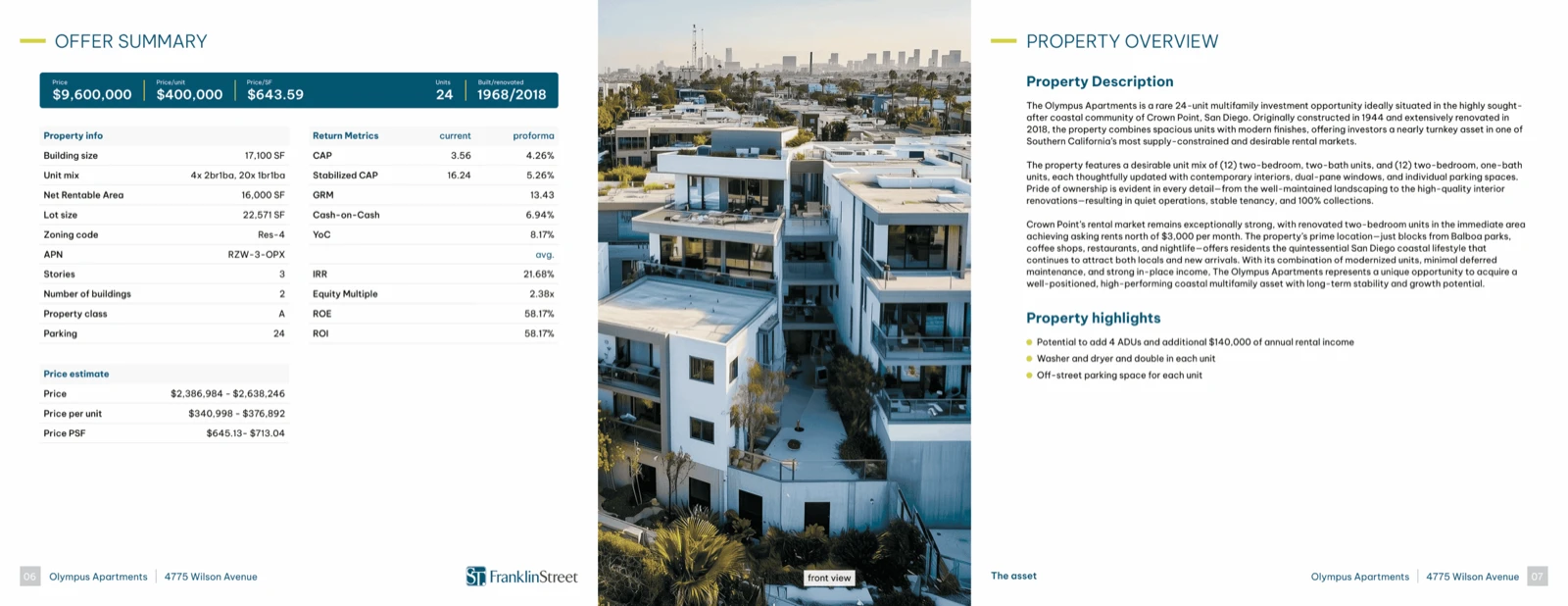
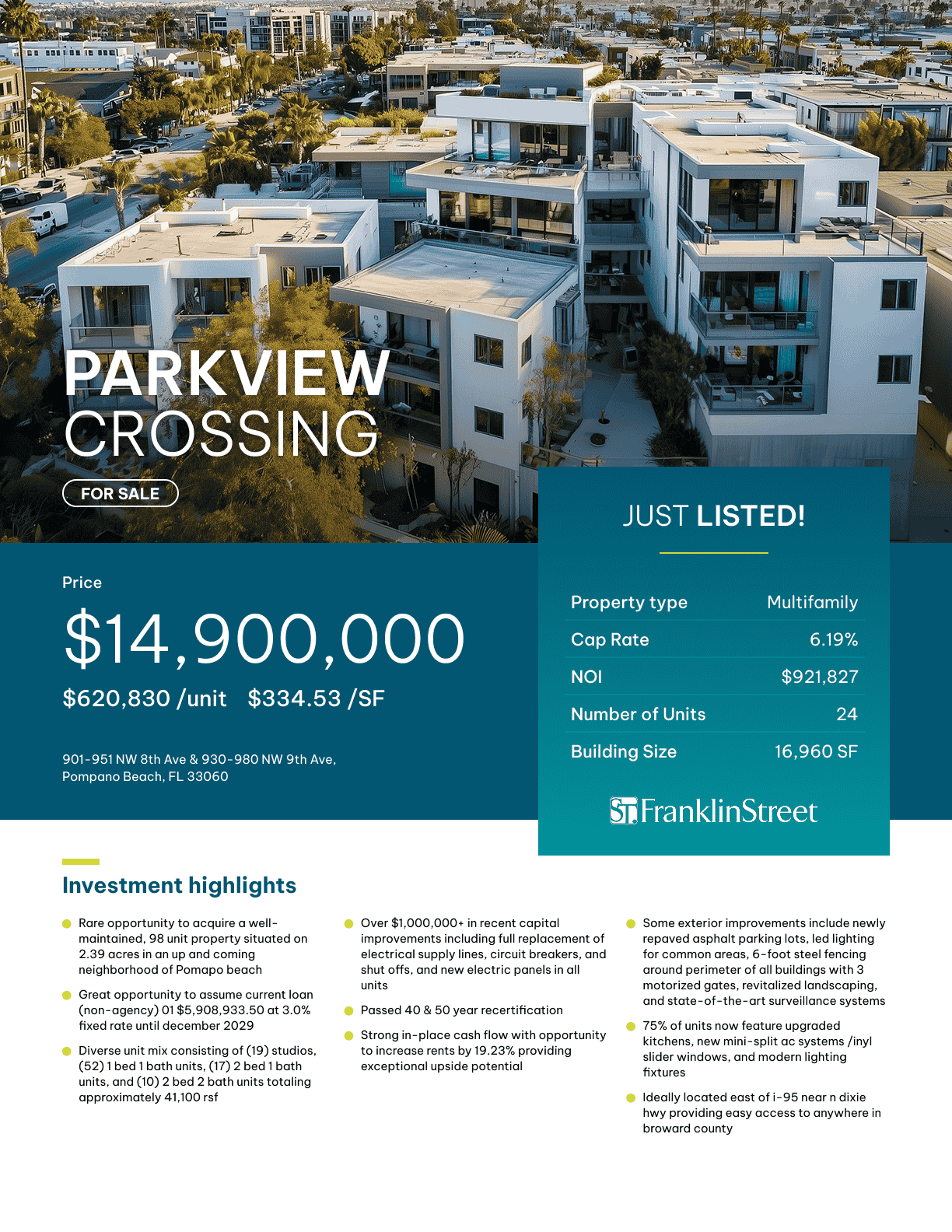
CoStar is a research and data platform. It does not generate OMs, BOVs, flyers, or listing websites. That's the job of a separate layer — and most brokers handle it manually, in PowerPoint or PDF templates, which is where the time goes.
The right mental model: CoStar (or its alternatives) is your research layer. IntellCRE is your production layer. You pull the comps and market data from CoStar, Crexi, or PropStream — then you feed that data into IntellCRE to generate the offering memorandum, BOV, and listing website in minutes instead of hours.
IntellCRE handles managing comps in IntellCRE directly in the platform — you can enter or import your comp data and it flows into the relevant sections of the OM and BOV automatically. The same intake also generates your AI underwriting output, so you're not rebuilding the financial model separately.
For brokers who downsize from CoStar to a lower-cost data stack: the operational risk is slower comp research and less granular analytics. The mitigation is building a few good relationships with appraisers and other brokers in your market who share comp data informally — which is how most experienced brokers operated before CoStar anyway.
The financial math: price your current stack against PropStream + Crexi Pro + freely published institutional data, using each vendor's own current pricing. For most independent brokers the gap is large enough to be worth the hour it takes to check. That delta funds better marketing production — which is where deals are actually won. A well-produced OM sent to a targeted buyer list outperforms a LoopNet premium listing more often than not.
Frequently asked questions
Is there a free alternative to CoStar?
Crexi's entry tier covers listing search and basic comp data, which handles many use cases. CBRE, JLL, and Cushman & Wakefield publish free quarterly market reports. For ownership data, some county assessor databases are searchable for free. None of these individually match CoStar's depth, but combined they cover the most common broker use cases.
Can I cancel CoStar and still do my job effectively?
It depends heavily on your property type and market. Office and retail brokers in top-25 MSAs who rely on lease comps for BOVs and appraisal support will feel the gap most. Industrial and multifamily brokers doing mid-market deals can typically replace CoStar with Crexi Pro and PropStream and maintain most of their research capability at significantly lower cost.
Does IntellCRE replace CoStar?
No, and it's not designed to. CoStar is a research and data platform; IntellCRE is a document generation and marketing automation platform. They serve different jobs in the broker workflow. The combination — data from CoStar or its alternatives, production from IntellCRE — is more efficient than either tool alone.