



What is Value-Add in CRE?
An investment strategy targeting properties with below-market rents, deferred maintenance, or operational inefficiencies — where the investor creates value rather than simply buying it.
Key takeaways
- Value-add is an investment strategy targeting properties with specific, addressable inefficiencies — not just any property with "upside potential"
- True value-add has a defined return profile: typically 8–12% IRR targets, 3–7 year hold periods, and a concrete value creation plan
- Using the term correctly — with specific improvement plans and realistic projections — builds credibility with sophisticated buyers; using it loosely raises red flags
- Brokers who can articulate the value-add thesis with precision and numbers move listings faster than those who rely on generic "repositioning upside" language
The plain-English definition
Value-add is a commercial real estate investment strategy that targets properties where the current income or condition is below what the asset could achieve with active management, capital investment, or operational improvements. Unlike a core investment — where you're buying a stabilized, fully-leased asset and holding for income — a value-add investor is buying a problem with the specific plan to fix it and capture the return created by the improvement.
Common value-add scenarios include: a multifamily property with rents 15–20% below market where new ownership plans a unit renovation and rent repositioning program; an industrial building with short-term leases that will roll to market rate within 24 months; a retail center with a vacant anchor space where the investor has a replacement tenant lined up; or an office property with deferred maintenance that is suppressing rents and occupancy.
The return profile for value-add investments is typically positioned between core (lower risk, 6–8% IRR targets) and opportunistic (higher risk, 15%+ IRR targets). Value-add generally targets 8–12% IRRs over 3–7 year hold periods, with returns driven more by forced appreciation from improvements than by market appreciation alone.
How brokers use it in practice
For listing brokers, "value-add" is one of the most powerful framing tools in CRE marketing — when used correctly. Positioning a property as value-add signals to buyers that there's a specific, identifiable opportunity to create returns through active management rather than simply riding market appreciation. That framing attracts a specific buyer type: operators with renovation experience, capital, and a tolerance for execution risk.
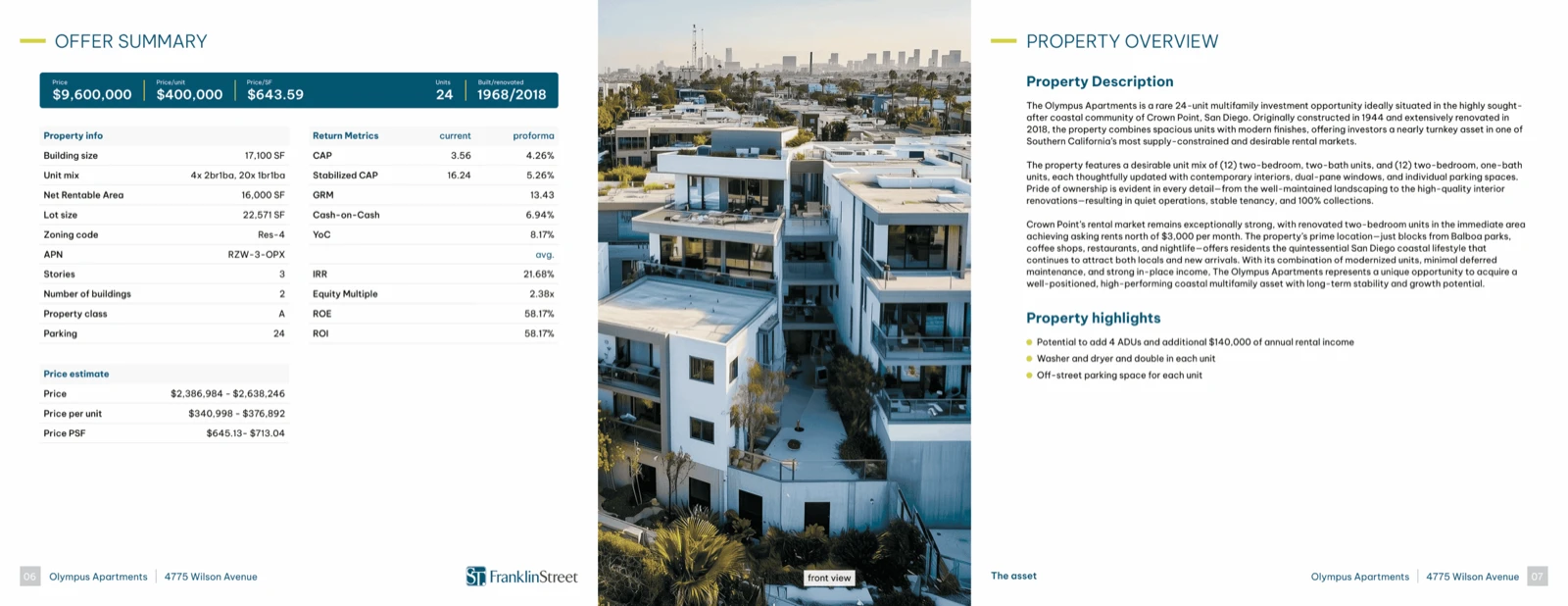
The key to using the term effectively is specificity. A listing that says "significant value-add opportunity" without supporting data is marketing language. A listing that says "current in-place rents are 18% below the submarket average of $1.85 PSF; 7 of 12 leases roll within 18 months, providing immediate repositioning opportunity" is a thesis. The second version attracts buyers who know how to underwrite it — and who will pay for the opportunity if the math works.
In offering memorandum preparation, the value-add story needs three components to be credible: the current state (what's underperforming and why), the improvement plan (what specifically will the new owner do, and at what cost), and the stabilized outcome (what does the asset look like at completion, what does the proforma show, and what exit cap rate supports the return target). Buyers who are serious about value-add will stress-test all three — so brokers who present all three upfront eliminate the friction of buyers building the case themselves.
Value-add is also a buyer segmentation tool. When you're building your outreach list for a value-add listing, you're not calling core buyers with low risk tolerance. The Listing Launch Guide covers how to segment your buyer list by deal type and deploy the right channel for value-add assets. You're calling operators, private equity shops with renovation capital, and experienced investors who have done this asset type before. The wrong buyer — even at a higher offered price — is more likely to retrade or fall out when renovation complexity surfaces in due diligence.
Common misconceptions
"Value-add" is one of the most overused and least precise terms in CRE marketing. The most common misconception is that any property with room for improvement qualifies as value-add. It doesn't. True value-add requires a specific, executable improvement plan — not just the observation that rents could be higher or the building could look better. "It has upside potential" is not a value-add thesis; it's a placeholder for the absence of one.
Sophisticated buyers — the ones you actually want bidding on a value-add listing — hear vague value-add language and become skeptical rather than excited. They've seen too many listings where "value-add" meant "the asset is distressed and the seller doesn't know why." The term has been diluted by overuse. Using it precisely, with supporting data, is what differentiates a credible deal story from marketing noise.
A second misconception is that value-add is purely about physical improvements. In many cases, the value is created through lease restructuring, operational efficiency improvements, or management changes — not necessarily capital projects. A poorly managed multifamily property where simple systems (maintenance response time, tenant screening, expense management) are improved can achieve value-add returns without a single renovation. The improvement plan needs to match the actual opportunity, not default to "renovate the units."
Finally, buyers sometimes confuse value-add with distressed. A distressed property has problems that may not be fixable — structural issues, environmental contamination, a market in secular decline. A value-add property has problems that are addressable, quantifiable, and executable within a reasonable capital and time budget. The distinction matters for underwriting, and brokers who can explain it clearly attract the right buyers instead of the wrong ones.
Frequently asked questions
What return should a value-add investment target?
Value-add typically targets levered IRRs of 8–12% over 3–7 year hold periods, with returns driven by a combination of forced appreciation (improvement-driven NOI growth) and exit cap rate compression at stabilization. Return targets vary by asset class, market cycle, and leverage — sophisticated buyers will have their own underwriting assumptions, but these ranges are widely used benchmarks.
How is value-add different from opportunistic investing?
Value-add investments have identifiable, addressable issues and execution risk is moderate — the property exists, has tenants, and generates some income. Opportunistic investments involve higher risk: ground-up development, major repositioning of distressed assets, or bets on market recovery. Opportunistic strategies typically target 15%+ IRRs to compensate for the additional risk.
What makes a compelling value-add story in an OM?
Three things: the current gap (rents X% below market, vacancy Y% above stabilized expectations), the specific improvement plan (unit renovation at $X per unit, new property management system, lease-up strategy with named tenant prospects), and the stabilized proforma with realistic return assumptions. Vague language about "upside potential" is the opposite of compelling.
Is value-add appropriate for every seller?
No. Value-add positioning is most effective when the property genuinely has addressable inefficiencies and when the seller is willing to price accordingly — below what a stabilized equivalent would trade for. A seller who wants a stabilized price for an unstabilized asset is pricing themselves out of the value-add buyer pool and confusing the core buyer pool. Pricing discipline is essential to making value-add marketing work.