


The 2026 headlines said deal volume came back. Look past the headline and it was more complicated. A few giant company-level mergers inflated the totals. Meanwhile, the deals most brokers actually work, single-property sales, stayed uneven month to month.
That’s the setup for 2027. Capital is available, but it’s picky. Owners face real decisions, but many of them are still waiting. For a broker, deal flow in 2027 won’t come from the market. It will come from how many qualified conversations you start, how fast you can put a credible number in front of an owner, and how disciplined you are about every deal after that.
Here’s what the data says, the seven practices you should implement to grow your brokerage business in 2027, and how to put your marketing workflow on AI so you can actually run them.
What the numbers say going into 2027
Loans are still coming due. The Mortgage Bankers Association projects $875 billion of commercial and multifamily mortgages maturing in 2026 and another $652 billion in 2027. MBA’s chief economist expects those maturities to fuel more lending activity. Every maturing loan is an owner who has to refinance, recapitalize, extend or sell. Each of those is a conversation.
Big deals hide a slower middle. According to MSCI data reported by CRE Daily, entity-level deals totaled $119 billion through August 2026. Individual property sales were still up 12% for the year through August, but they fell 28% year over year in August itself. The takeaway for brokers: the volume your peers quote at conferences isn’t the volume you’ll be competing for.
Capital wants to be selective. Deloitte’s 2027 outlook, which surveyed 950 CRE executives, describes a market that rewards disciplined, asset-by-asset decisions. Nearly 80% of respondents plan to upgrade or reposition assets over the next 12 to 18 months. Repositioning means valuations, recapitalizations and dispositions, and owners will want an advisor’s view before they commit.
Almost everyone is spending on technology. Few have put it to work. In the same Deloitte survey, more than 90% expect to increase data and technology spending, but just 8% say AI solutions are integrated. JLL’s 2026 Future of Work Survey of more than 2,200 C-suite and CRE leaders found 78% expect AI to drive significant changes to their real estate portfolio strategy, yet only 31% are actively preparing their space for it. That gap between intent and execution is an opening for brokers who move first.
For a broker, deal flow in 2027 won’t come from the market. It will come from how many qualified conversations you start, how fast you can put a credible number in front of an owner, and how disciplined you are about every deal after that.
7 best practices for CRE deal flow in 2027
1. Build your prospect list around the maturity calendar
Most prospecting lists are built by geography or asset type. In 2027, add a third filter: when does the owner’s debt come due?
An owner with a loan maturing in the next 6 to 18 months has a deadline, and a deadline creates urgency for a conversation. Pull maturity dates from your research tools and the public record where you can, and sort your outreach by them. Start the conversation before the lender’s term sheet shows up, not after. By then the owner has usually picked an advisor.
2. Make “time to pitch” a number you track
Ask most brokers why they lost a listing and they’ll point to the fee or the other broker’s relationship. Look harder at many teams, and the real constraint is how many pitches they can produce. Almost 90% of the brokerage teams we talk to admit production, not price, is what limits how many owners they pitch. A good broker opinion of value (BOV) takes real work: comps, rent roll, a pricing view and a document the owner will take seriously. When each one takes hours of your team’s time, or waits in a marketing queue, you pitch fewer owners than you could.
So measure it. How many days pass between an owner saying “sure, tell me what it’s worth” and that owner holding your BOV? Track it the way you track listings won. Cut it in half and you can make more pitches at the same cost, and a faster pitch gets you in the conversation while the owner is still interested.
Look harder at many teams, and the real constraint is how many pitches they can produce.
3. Never build the same document twice
The fastest teams treat marketing materials as a library, not a series of one-offs. The pricing page from last month’s BOV becomes the starting point for this month’s. The property and market pages you built for the pitch become the first pages of the offering memorandum (OM) once you have it.
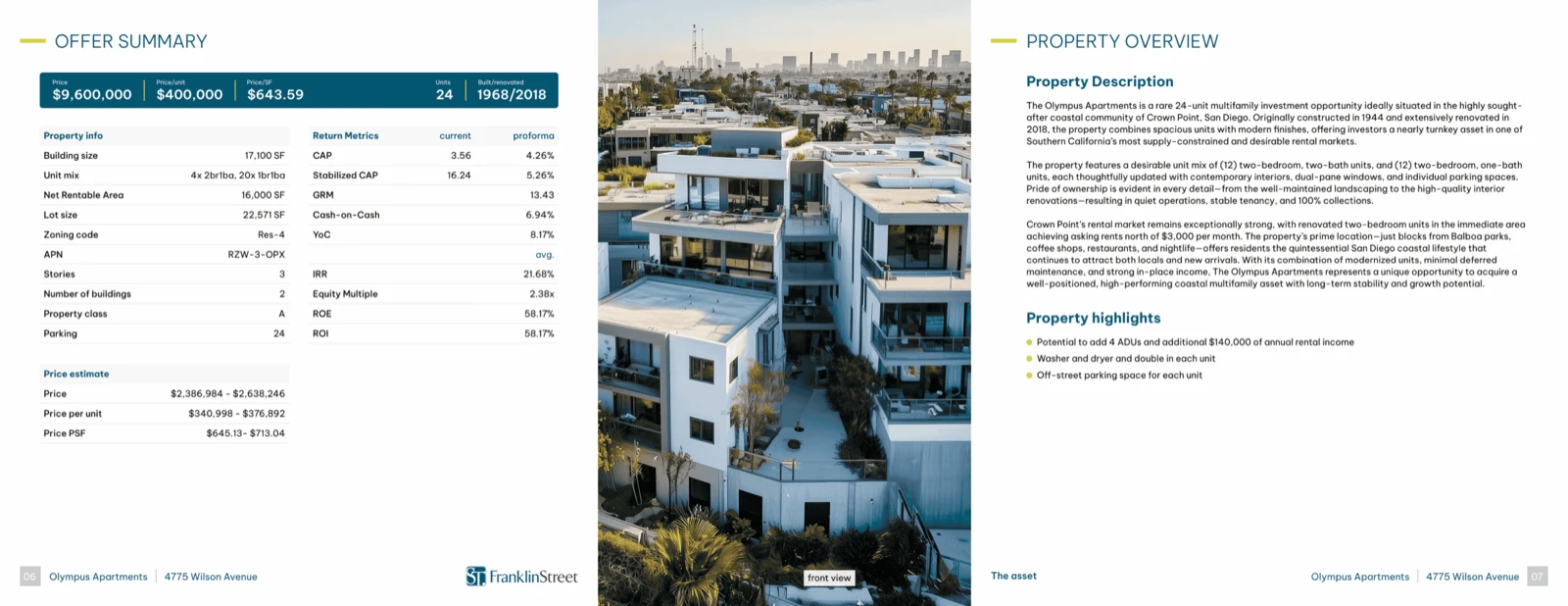
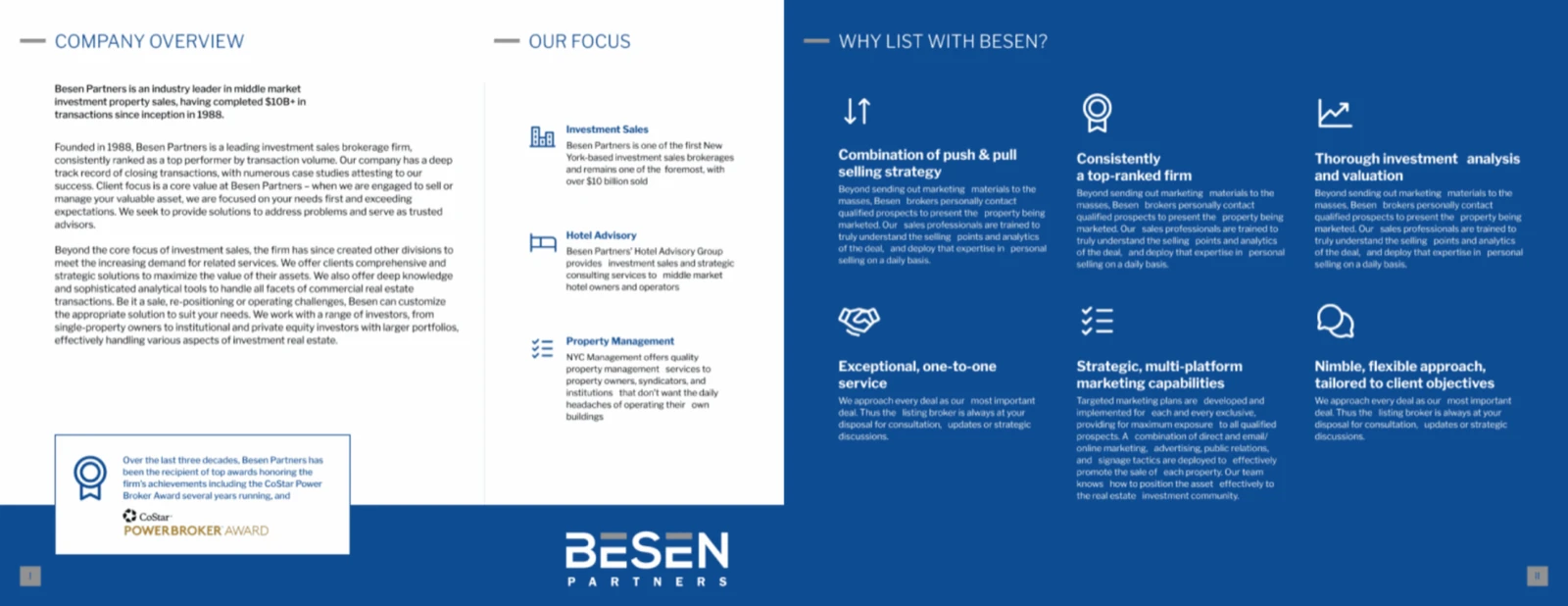
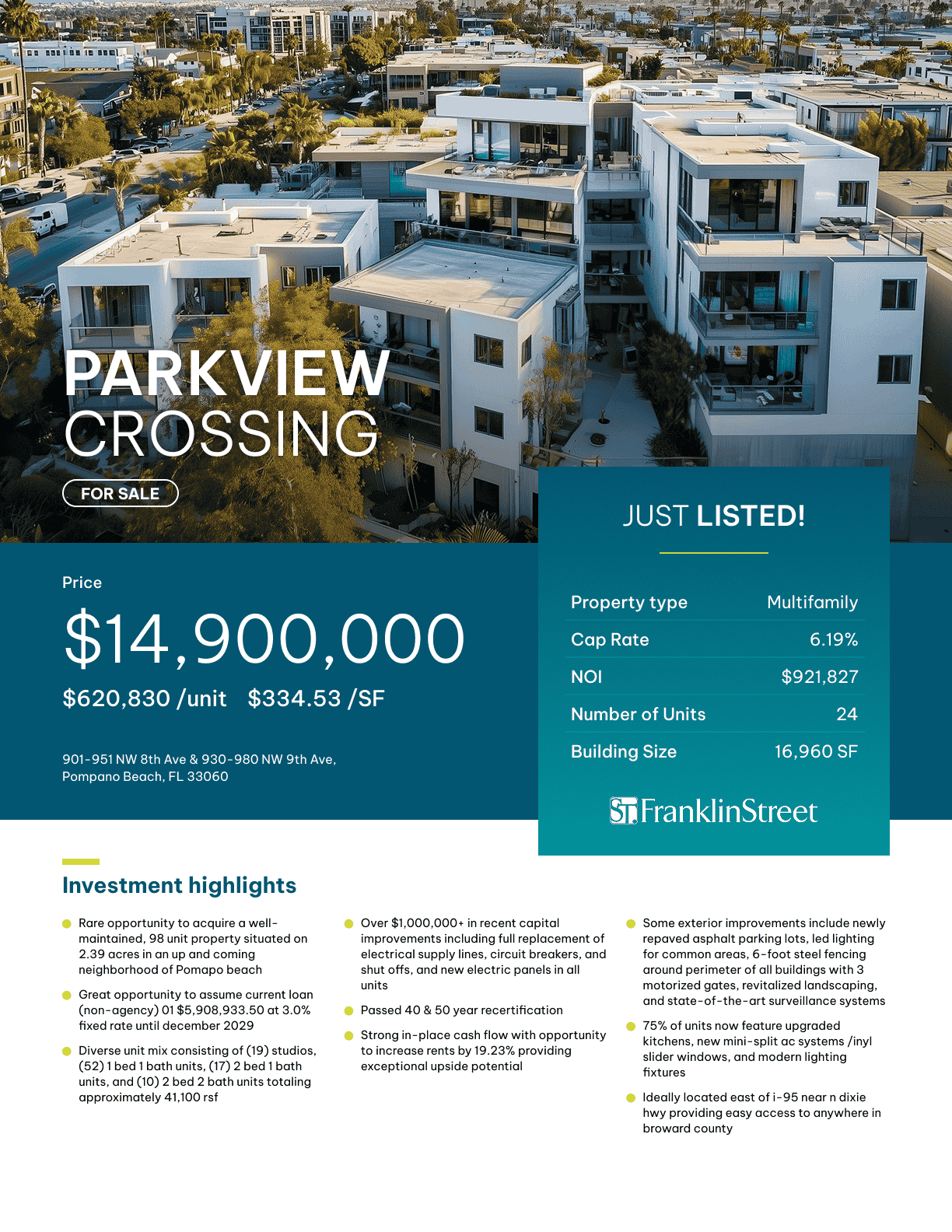
Standardize your outlines for each document you produce often: the BOV, the OM, the sale flyer and the lease flyer. Decide what pages go in each, in what order, and in your brand. Then every new deal starts from a proven structure instead of a blank page. In IntellCRE, this is now built in: the app includes ready-made outlines for a multifamily OM, a retail BOV, and sale and lease flyers, and your team can save its own outlines to reuse on every deal.
4. Run your pipeline on dates, not hope
Pipelines rot quietly. A deal sits in “proposal sent” for three months with a next step dated weeks ago, and everyone keeps it there because closing it out feels like losing it.
Three habits fix most of this:
- Every open deal has a next step with a date on it. “Follow up” is not a next step. “Call the owner Tuesday about the pricing scenarios” is.
- Every deal has a real decision date, agreed with the client, not a default close date your CRM filled in.
- Every deal has a kill date. If nothing has moved by then, close it out with a reason and put the contact in a nurture sequence. An honest pipeline tells you where your 2027 revenue will actually come from.
Review it weekly, and be strict about it. The deals you clear out free up time for the ones that can close.
5. Reach the decision maker, and answer the same day
Two patterns cost brokers deals that price never explains. The first is spending weeks with an evaluator, an analyst or coordinator, while the person who signs never sees your work. The second is slow responses at the moment the client is ready to move.
Early in every engagement, ask who makes the final call and get that person into a meeting. Keep a regular check-in cadence with them, not only with the day-to-day contact. And when a decision maker asks for a call, get on their calendar that day. In a selective market, responsiveness is part of what owners are evaluating.
6. Make outreach about their property, not your firm
Generic emails about your firm’s track record get ignored. Outreach that names the owner’s property, its likely value range and what’s changed in its submarket gets read, because it’s about something the owner already cares about.
Put the property address in the subject line. In our own outreach, putting the property address in the subject line roughly doubled open rates. Lead with one specific observation: a comparable sale nearby, a shift in rents, or the loan maturity you know is coming. Offer something concrete, like a quick opinion of value. Then follow up on a schedule. Most replies come after the first email, not from it.
7. Use AI as an assistant, and check its work
The surveys above say the industry wants AI, but very few firms have actually put it to work. That’s an advantage for brokers willing to use it well: drafting property descriptions and market summaries, pulling data out of rent rolls and operating statements, and assembling first drafts of marketing materials.
The rule is simple: AI drafts and you decide. Every number in a BOV or OM still needs a broker’s eye, because your name is on it. Use AI to clear the assembly work off your desk so your time goes to pricing judgment, owner relationships and negotiation, which are the parts of the job no software does for you. Tools built for CRE marketing can now turn an uploaded data room into a first-draft OM in minutes. That draft is a starting point for your review, not a replacement for it.
Put your marketing workflow on AI
Every practice above runs into the same limit: production. Prospecting by maturity date means more owners to pitch. Tracking time to pitch means faster BOVs. Answering the same day means the proposal has to be ready when the owner is. Few teams can hire their way to that volume. In 2027, the brokerages that grow will be the ones whose marketing runs on AI, with brokers reviewing the work instead of assembling it. Just 8% of executives in Deloitte’s survey say AI is integrated, so that lane is still open.
Here’s a workflow you can put in place this quarter:
- Gather the deal package once. Rent roll, T-12 or operating statements, your comps, photos and, if you use one, your own Excel model. That’s the raw material for every document on the deal.
- Let AI assemble the first draft. Use a tool that builds what the moment calls for: a BOV or pitch deck to win the assignment, then the OM, flyer and property website once you have it.
- Spend your time on the review. Check every number against the source, set the pricing view yourself, and rewrite anything that doesn’t sound like you. Your name is on it.
- Send the proposal while the owner is still interested. In a listing pitch, quality and speed win together. A sharp, branded proposal delivered the day the owner asks beats a perfect one a week later.
- Keep follow-up running off the same material. The comps and market pages from your pitch become the specific observation in your next owner email and every follow-up after it, so outreach stays consistent without extra writing.
- Measure it. Compare your days from “tell me what it’s worth” to BOV delivered, before and after. If the number didn’t drop, find the step that’s still manual.
The rule is simple: AI drafts and you decide. Every number in a BOV or OM still needs a broker’s eye, because your name is on it.
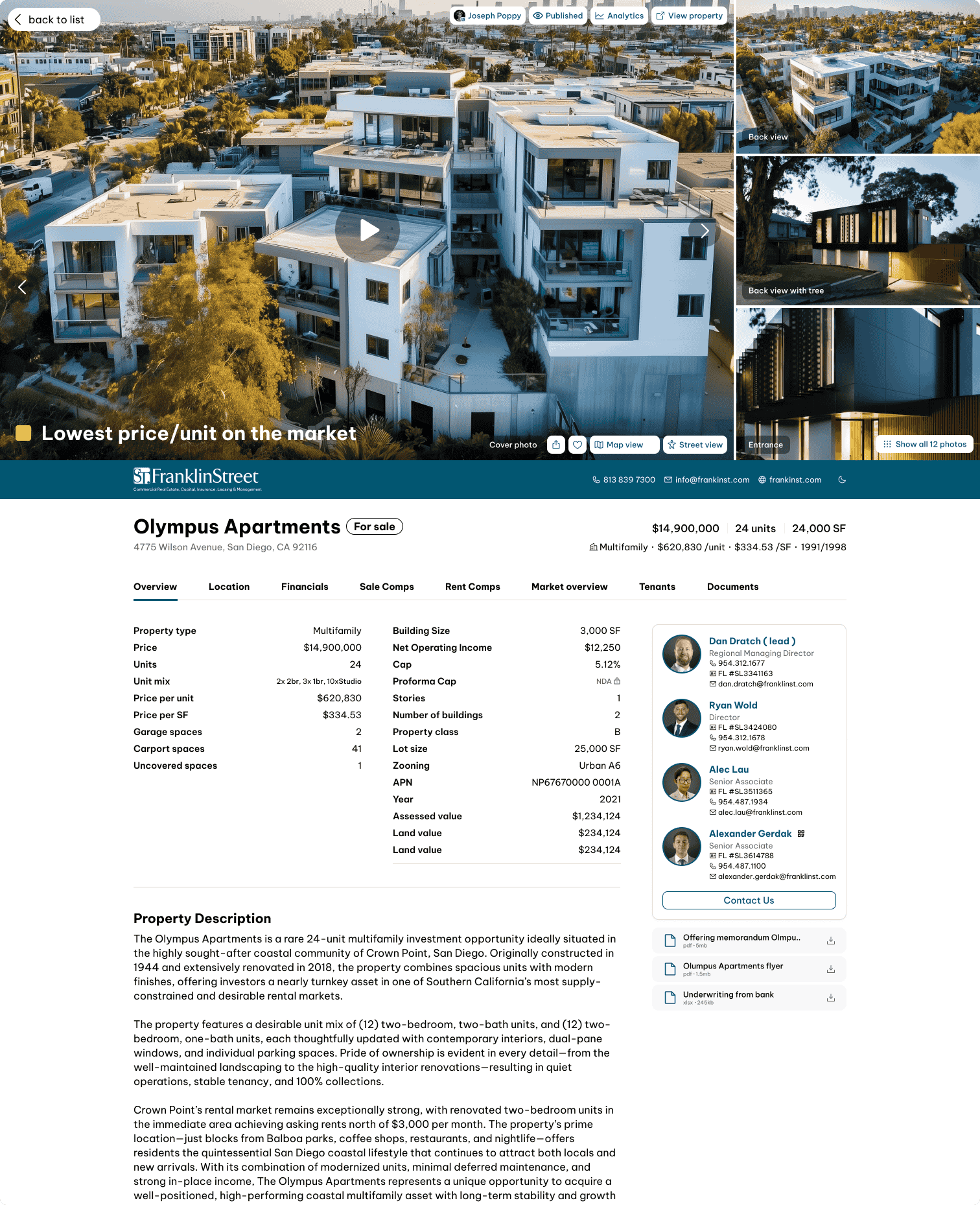
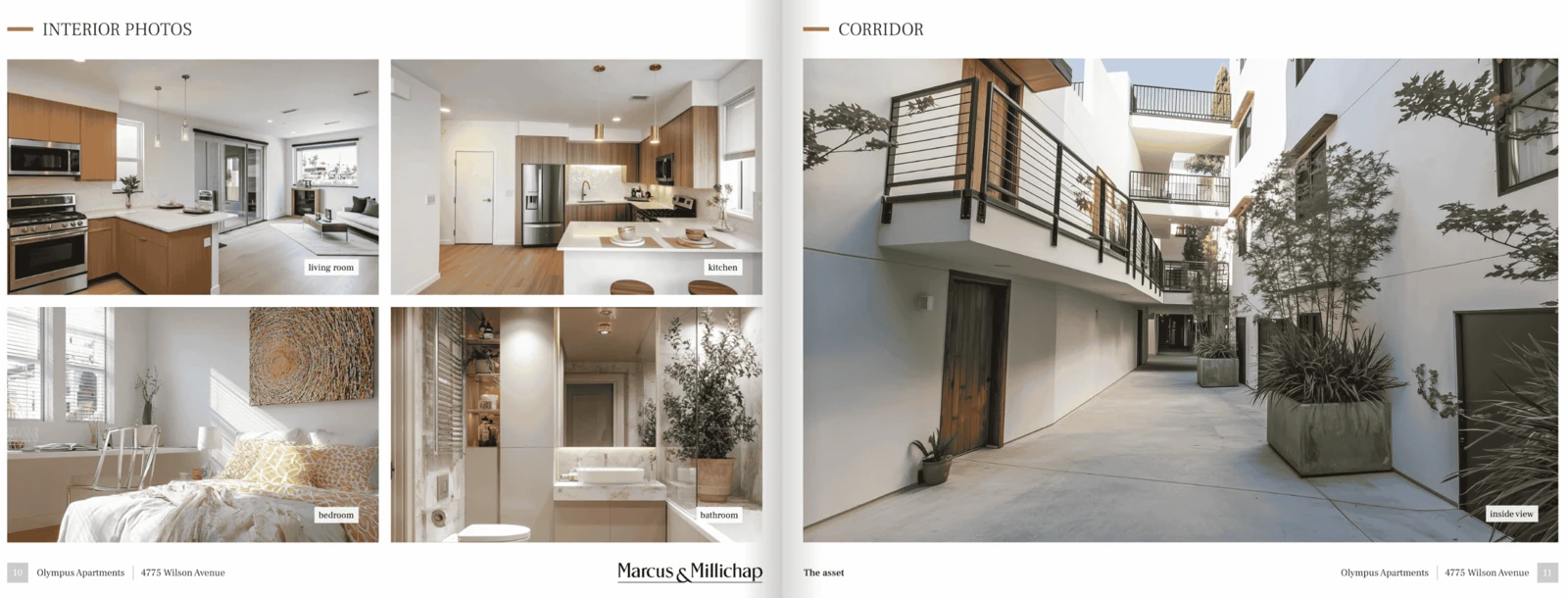
What you get back is capacity: more pitches with the same team, faster follow-up, consistent branded materials on every deal and far less manual formatting. It’s the workflow we built IntellCRE around. Upload a deal’s financials and photos, and it produces a branded BOV, pitch deck, OM, flyer or property website for your team to review and send.
A 2027 deal-flow checklist
- Start with a streamlined, fully-branded AI marketing workflow built for CRE brokers
- Sort your top 100 prospects by loan maturity date and start with the next 18 months.
- Write down your average days from “tell me what it’s worth” to BOV delivered, and set a target.
- Standardize outlines for your BOV, OM and flyers in your brand.
- Give every open deal a dated next step, a decision date and a kill date.
- Name the decision maker on every active deal, and meet them.
- Rewrite your outreach template so it opens with the owner’s property.
- Run your next BOV or proposal through an AI workflow end to end, review every number, and compare your delivery time with your last one.
The bottom line
The market in 2027 won’t hand anyone deal flow. Debt is maturing, owners face repositioning decisions, and capital is selective. That adds up to more owners who need an advisor. The brokers who win will start those conversations earlier, put a credible number in front of an owner faster, and run every deal with discipline from first call to close.
Sources
- Mortgage Bankers Association, “17% of Commercial and Multifamily Mortgage Balances to Mature in 2026,” MBA NewsLink, Feb. 2026: https://newslink.mba.org/mba-newslinks/2026/february/mba-newslink-tuesday-feb-10-2026/17-of-commercial-and-multifamily-mortgage-balances-to-mature-in-2026/
- CRE Daily, “M&A Megadeals Mask a Slowdown in CRE Transaction Volume” (MSCI data), Sept. 30, 2026: https://www.credaily.com/briefs/ma-megadeals-mask-a-slowdown-in-cre-transaction-volume/
- CRE Daily, “CRE Heads Into 2027 With Capital to Spend, But Not Everywhere” (Deloitte 2027 outlook), Sept. 28, 2026: https://www.credaily.com/newsletters/national/issue/cre-heads-into-2027-with-capital-to-spend-but-not-everywhere/
- JLL, “AI redesigns jobs, not cuts them” (2026 Future of Work Survey): https://www.jll.com/en-uk/newsroom/ai-redesigns-jobs-not-cuts-them